If you want a garden chicken that looks like a show bird, keeps laying when the weather turns miserable and does not launch itself over the fence the moment your back is turned, the Wyandotte is hard to beat. It is one of the most popular heritage breeds with British keepers, and for good reason. This guide walks a first-time keeper through where the breed came from, why it suits our climate so well, how many eggs to expect, and the one legal step every keeper now has to take.
For the wider picture of choosing a first flock, start with our guide to keeping chickens and our roundup of the best chicken breeds for a UK back garden.
Where do Wyandotte chickens come from?
The Wyandotte is an American breed, developed in the United States during the 1870s and 1880s and named after the Wyandot people. The Silver-Laced Wyandotte was the original variety, first shown under the name "American Sebright" before being renamed and admitted to the American Poultry Association's Standard of Perfection in 1883. Its exact ancestry is a little murky, but the Dark Brahma and the Spangled Hamburg are usually credited in the mix.
From the start it was bred as a dual-purpose farm bird: a reliable layer of brown eggs on a broad, meaty frame. That practical heritage is exactly why it travelled so well and why it settled so happily into British smallholdings and back gardens. The breed was once a conservation-priority bird in its homeland but recovered strongly and graduated off The Livestock Conservancy's list in 2016, so healthy stock is now easy to find here.
Why is the rose comb such an advantage in a British winter?
This is the detail that makes the Wyandotte genuinely well matched to our climate. Instead of a tall, upright single comb, the Wyandotte carries a rose comb: low, flat and studded with small rounded points, sitting close to the head.
That shape matters. A comb is thin, exposed tissue with a big surface area, and in freezing, damp weather it is the first thing to suffer frostbite. Small combs that lie low to the skull hold far less exposed tissue and stay closer to the bird's body heat. As the US Cooperative Extension's poultry service puts it, "any hen with a large comb, such as a leghorn, can be vulnerable" to frostbite, while "the incidence of frostbite in chickens with the smaller comb types... is much less."
The rose comb is not just handsome. On a frosty, wet British morning it is the difference between a comfortable hen and a painful case of frostbite.
Compare that to a Leghorn, which carries a large single comb and, in a hard UK frost, is one of the breeds most likely to need extra winter care. The Wyandotte's rose comb, paired with its dense, fluffy feathering, means it takes cold and wet in its stride with very little fuss from you.
What do Wyandottes look like?
Stunning, frankly. The classic look is lacing: every feather edged in a contrasting colour so the whole bird appears drawn in fine outline. The Silver-Laced (white feathers rimmed in black) is the original and still the most recognisable, but there is a long list of colours to choose from, including Gold-Laced, Blue-Laced, buff, Columbian, partridge, silver-pencilled, black, blue and white.
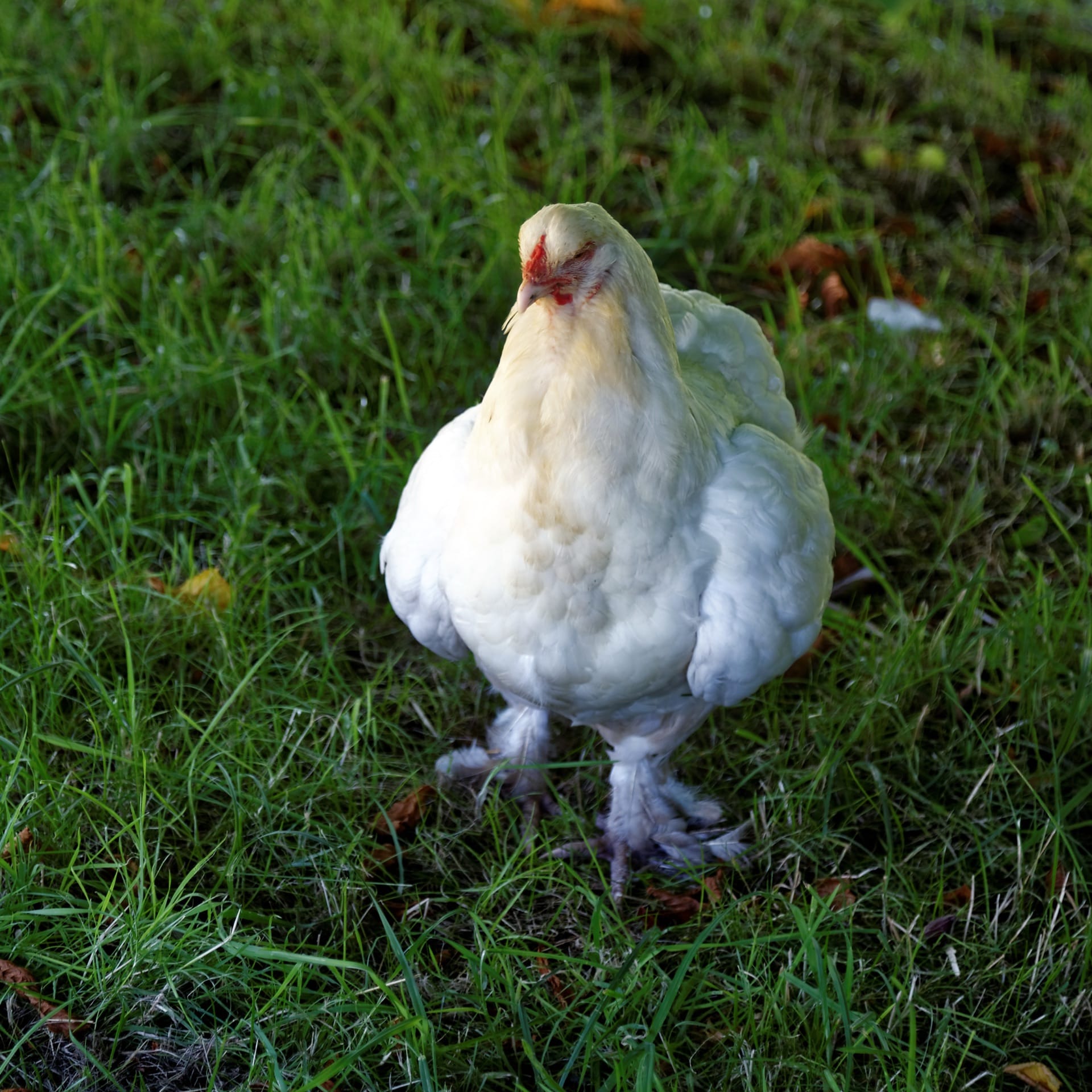
They are rounded, broad-bodied birds with clean yellow legs and a full, curvy outline that shows off the lacing beautifully. There is also a very popular bantam Wyandotte, a miniature version in the same colours, which is ideal if you have a smaller garden but still want the looks and the calm temperament in a bird that eats less and needs less space.
Are Wyandottes good for beginners and families?
Yes, and this is a big part of their appeal. Wyandottes are consistently described as calm, friendly and docile, and reputable breed sources note they are good around children. They are curious and confident without being pushy, and they are not flighty, so they settle into a routine quickly and are forgiving of a new keeper still finding their feet.
Their steady nature also makes them easy to handle for health checks and easy to keep in a normal garden run, which we will come back to. If you want an even-tempered flock that your kids can help look after, they sit comfortably alongside breeds like the Sussex and the Orpington as classic family-friendly choices.
How many eggs do Wyandottes lay, and are they good for meat?
As a true dual-purpose breed, the Wyandotte gives you a bit of both.
On eggs, a healthy hen lays roughly 180-240 large, light-brown eggs a year, which works out at about four or five a week when she is in full lay. That is a solid, dependable output rather than a record-breaking one, and the bonus for UK keepers is that Wyandottes tend to keep laying through the colder months better than many breeds, so your egg basket does not empty out completely over autumn and winter.
On meat, they carry a broad, well-muscled body. A standard hen weighs around 2.95 kg (about 6.5 lb) and a cock around 3.85 kg (about 8.5 lb), so surplus cockerels make a worthwhile table bird if you plan to raise your own. Compared with a pure laying breed, you trade a few eggs for a much meatier carcass.
Are Wyandottes hardy in wet British weather?
Very. Alongside the frostbite-resistant rose comb, Wyandottes have dense, tight feathering that traps warmth and sheds rain well, so they are comfortable in the cold and damp conditions that define a British winter. They are one of the breeds most often recommended specifically for cold climates.
They can also go broody, though not as predictably as some sitting breeds. When a Wyandotte does decide to sit, she usually makes a steady, reliable mother, which is a real plus if you would rather hatch chicks the natural way under a hen than run an incubator. If you do not want chicks, just collect eggs promptly and a broody hen will usually give up after a while.
How do you house and care for Wyandottes?
Care is standard good chicken-keeping, with one happy quirk: because Wyandottes are heavy-bodied and do not fly much, they are easier to keep behind a normal fence than a light, athletic breed like the Leghorn. A modest run wall or fence that a Leghorn would clear for fun is usually plenty to contain a Wyandotte.
- 1
Build or buy a secure, fox-proof coop
Foxes are the number-one threat to UK garden hens, day and night. Use a solid house and a run with weldmesh (not flimsy chicken wire), a dig-proof skirt or buried mesh, and a secure door you shut every evening.
- 2
Give them enough space
The RSPCA advises around 1 square metre of housing per bird where possible, and no more than three birds per square metre. Provide perches roughly 3 to 5cm wide with about 15cm of perch space per bird, plus quiet nest boxes for laying.
- 3
Keep at least three birds
Chickens are sociable and get stressed alone. The RSPCA recommends keeping at least three hens that get along, so they can forage, roost and dust-bathe together.
- 4
Feed a proper layers ration and fresh water
Give a complete layers pellet or mash for adult hens, with grit for digestion and constant clean water. Treats and greens are fine in moderation but should not replace the balanced feed.
- 5
Keep it dry and check them over
Their dense feathering handles cold well, but damp bedding causes problems. Use dry litter such as wood shavings, muck out regularly, and check regularly for mites, lice and any signs of ill health.
How do Wyandottes compare to Sussex, Orpington, Rhode Island Red and Leghorn?
Every one of these is a good garden breed, so it comes down to what you want most.
- Wyandotte is the balanced all-rounder: showy lacing, calm nature, strong winter hardiness, a low frostbite-resistant rose comb, and a fair 180-240 eggs a year on a meaty frame.
- Sussex is a friendly, dependable British breed and often a slightly heavier layer, a very close rival for the family garden.
- Orpington is the gentle giant: enormous, soft-feathered and superb with children, but a more modest layer and a bigger eater.
- Rhode Island Red is the workhorse layer, edging ahead on egg numbers but a touch more businesslike in temperament.
- Leghorn is the egg machine and lays prolifically, but it is lighter, more flighty and harder to contain, and its large single comb is much more prone to frostbite in a UK winter. This is the clearest contrast with the Wyandotte: for reliable eggs the Leghorn wins, but for a calm, easy-to-keep, cold-proof garden bird the Wyandotte is the safer beginner's choice.
Related guides and tools
If you are weighing up the Wyandotte against other calm, hardy garden breeds, read our companion guides to the Sussex, the Orpington and the more flighty Leghorn so you can see the trade-offs side by side. For the bigger decision of which breed suits your space and family, our best chicken breeds for a UK back garden roundup pulls them all together.
Before you buy, it is worth doing two quick checks. Use our chicken cost calculator to work out the real setup and running costs of a small flock, and run our can I keep chickens checker to confirm there are no restrictions where you live. Do both and you will start your Wyandottes on the right foot.
Frequently asked questions
Sources
- Register as a keeper of poultry or other captive birds , GOV.UK (Defra / APHA)
- New mandatory bird registration: what keepers need to know , GOV.UK Government Vets blog
- Keeping chickens as pets: caring for backyard hens , RSPCA
- Wyandotte Chicken breed profile , The Livestock Conservancy
- Wyandotte chicken , Wikipedia
- Frostbite in Chickens , Poultry Extension (US Cooperative Extension)
Kit for this job (Ad)

FeelGoodUK Coop House Chicken Coop, Large
Check price on Amazon →
FeelGoodUK CHICKEN COOP HEN HOUSE POULTRY ARK HOME NEST RUN COUP WITH INTEGRA...
Check price on Amazon →
Cocoon ECO 6002N Chicken Coop – Wooden Hen House with Rot-Proof Plastic Roofs, Pull-Out Tray & Nest Box – Ideal for 4–6 Birds
Check price on Amazon →
Cocoon ECO 1000 Large Chicken Coop – Wooden Hen House with Rot-Proof Plastic Roofs, Dual Pull-Out Trays, Secure Nest Box & Auto Door Ready, Ideal for 6–8 Birds
Check price on Amazon →We may earn a small commission, at no cost to you. We only list kit we'd use.
Written by
UK Homesteading Team
Editorial team
The UK Homesteading editorial team, offering UK-specific, evidence-led guidance on growing, keeping, preserving and the law.