Where do Marans chickens come from?
The Marans is French, and proudly so. The breed takes its name from the port town of Marans, on the marshy Atlantic coast of the Charente-Maritime in south-western France, where it was developed from local farmyard fowl crossed with game birds brought in by ship. It arrived in Britain in the 1930s and has been quietly winning over keepers ever since, mostly on the strength of one remarkable trick: the eggs.
It's a proper dual-purpose bird, which is to say it was bred to earn its keep twice over, for eggs on the doorstep and meat on the table. Cocks weigh around 3.5 to 4 kg and hens 2.5 to 3.2 kg, so a Marans is a solid, sturdy chicken rather than a dainty one. That heft is part of why they're so calm and so hardy in a wet British winter.
What makes Marans eggs so dark?
This is the whole point of the breed. A good Marans egg is a rich, dark chocolate-brown, sometimes almost mahogany, and it genuinely does look like it belongs in a chocolate box rather than an egg box. Among the common breeds, only a Welsummer comes close, and the best Marans go darker still.
Breeders don't just eyeball it either. There's an official Marans egg-colour chart, running roughly from 1 at the pale end (a nearly white shell) up to 9 at the darkest (an intense, near-black brown). A shell around 4 is an ordinary brown egg. A good breed-standard Marans egg sits high up the scale, around 5 to 7, and anything pushing 8 or 9 is exceptional and rare. When people talk about "number 7 eggs", this is the chart they mean.
Why does the egg colour fade through the year?
Here's the thing new Marans keepers often panic about, so it's worth saying plainly: your eggs will get lighter as the year goes on, and that's completely normal.
A hen lays her very darkest eggs right at the start of her laying season. Each successive egg tends to come a shade paler, because she only has so much pigment to hand out and the eggs themselves get a touch larger. By high summer, with warmer weather softening the colour too, you'll notice the shade has drifted from deep chocolate towards milk chocolate. Then she moults, has a rest, and when she starts up again the deep colour comes flooding back. It runs in a cycle, year after year.
A Marans lays her darkest egg of the whole year on her very first day back in lay. It's downhill for the colour from there, until she moults and resets.
None of this is a fault, a deficiency or a sign of illness. It catches people out because a photo of a "number 8" egg online is almost always somebody's first-of-season showstopper, not what that hen lays every single morning. Judge your birds on their spring eggs and you'll be much happier.
Which Marans variety should you get?
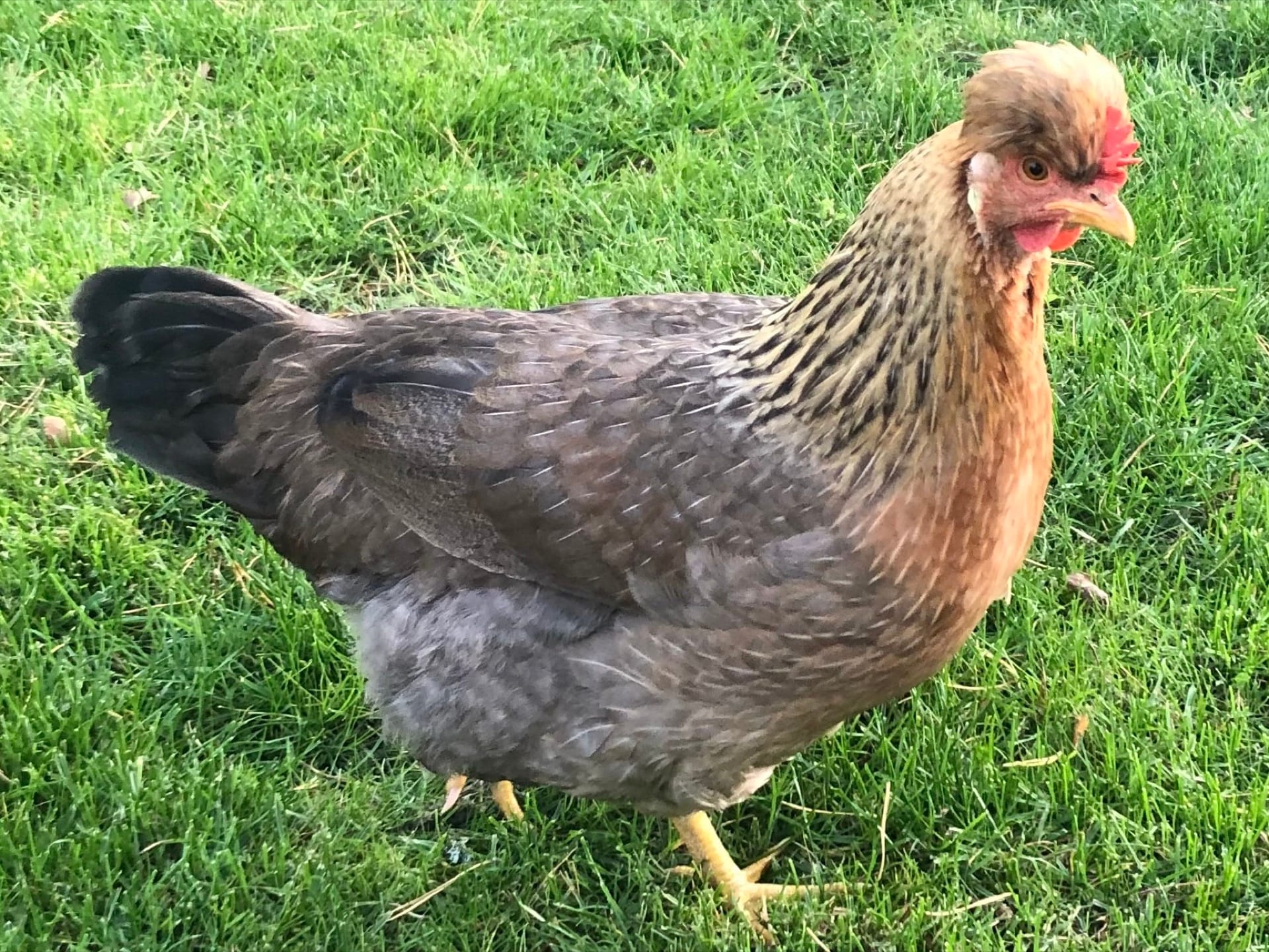
Marans come in a whole spread of colours, and which ones you'll find depends a lot on where you are. In the UK the Poultry Club recognises several, including black, the cuckoo varieties (dark, golden and silver) and copper-black.
- Cuckoo (barred grey): by far the most common Marans in Britain, and the easy place to start. A handsome soft grey-and-white barring, reliable, and widely available from breeders.
- Black Copper: the celebrity of the breed and the one the show world obsesses over for the very darkest eggs. Glossy black with a wash of coppery-red on the neck. Harder to find and pricier here.
- Silver Cuckoo and Golden Cuckoo: variations on the barred theme, lighter or warmer in tone.
- Wheaten, Black and others: less common in the UK but out there if you go looking.
There's one quirk worth understanding before you buy, because it trips people up. The English standard Marans has clean, unfeathered legs. The French standard has lightly feathered legs (feathering down the shanks). Both are "real" Marans; they're just two national takes on the same breed. Cuckoos here are usually clean-legged, while the Black Copper often carries the French feathered leg. Decide which you'd rather look after, because feathered feet come with a small catch, covered below.
What are Marans like to keep?
Lovely, honestly. Marans are generally calm, quiet and steady birds. They're not flighty, they don't tend to be flock bullies, and they rarely make the racket that gets a keeper in trouble with the neighbours. That easy temperament, plus a good tolerance of cold and damp, is exactly why they're a sound pick for a first-time keeper who wants something more interesting than a hybrid.
On eggs, set your expectations sensibly. A Marans is a moderate layer, roughly 150-200 dark eggs a year, or about three a week through the main season. That's fewer than a purpose-bred laying hybrid, and it's the usual bargain with the dark-egg breeds: you trade a bit of quantity for that unbeatable colour. As a dual-purpose bird they also grow a decent carcass, though most people keep them for the eggs and the pleasure of the thing.
How do you house and care for Marans?
Marans want the same solid, sensible set-up as any back-garden flock, with a couple of breed-specific notes. Chickens are sociable, so keep at least three together rather than a lonely pair.
- 1
Give them a dry, airy coop
A warm, dry, well-ventilated house with perches and nest boxes. The RSPCA suggests at least 1 square metre per bird. Damp and stale air cause far more winter trouble than cold ever does, and a sturdy breed like the Marans shrugs off British cold easily once it's kept dry.
- 2
Fox-proof the run properly
Foxes are the number-one killer of garden hens. Use strong mesh fencing around 6ft high, sloped outwards at the top, and either dug about a foot into the ground or fitted with a mesh skirt so nothing can dig under. Shut every bird into the coop at dusk, without fail.
- 3
Keep feathered-leg strains out of the mud
If you've chosen a French feathered-leg Marans, keep the run dry and well-drained. Feathered shanks pick up mud and droppings, which cakes on and can lead to sore feet or scaly-leg mites. Clean-legged English birds don't have this worry. A layer of woodchip or hardstanding helps a lot.
- 4
Feed, water and the daily check
A good layers' pellet, grit for strong shells, and clean water topped up daily (swapped out when it freezes in winter). A quick look over the flock each day catches problems early, from a hen off her food to the first sign of red mite in the coop.
Marans or Cream Legbar? Building a colourful egg basket
If the appeal of Marans is really the eggs, and for most of us it is, the fun starts when you mix breeds. A Marans gives you the deep chocolate-brown. Pair it with a Cream Legbar, the British breed that lays blue and blue-green eggs, and suddenly your egg basket runs from near-black through to duck-egg blue, with ordinary brown hybrids filling in the middle. It's the same trick a florist plays with colour, only edible, and it costs you nothing beyond choosing your birds well.
The two breeds get along in temperament, too. Marans are the calm, quiet, cold-hardy pillar of the flock; Legbars are a touch more active and flighty but lay more heavily. Between them you get colour, character and plenty of eggs. If you're weighing up which breeds to start with, our roundup of the best chicken breeds for a UK back garden is a good next read, and a Wyandotte makes a third handsome, docile option if you fancy rounding out the trio.
Related guides and tools
- The best chicken breeds for a UK back garden if you're still choosing your flock.
- Keeping Cream Legbar chickens in the UK, the blue-egg breed that partners a Marans perfectly.
- Keeping Wyandotte chickens in the UK, another calm, hardy breed for beginners.
- Not sure whether you're allowed hens where you live? Try our can I keep chickens? checker.
- Work out the real running costs before you buy with the chicken cost calculator.
See more in all our chicken guides.
Frequently asked questions
Sources
- New mandatory bird registration: what keepers need to know , APHA / Defra (gov.uk)
- Register as a keeper of poultry or other captive birds , GOV.UK
- Keeping chickens as pets , RSPCA
- Marans - origin, varieties and dark eggs , Wikipedia
Kit for this job (Ad)

FeelGoodUK Coop House Chicken Coop, Large
Check price on Amazon →
FeelGoodUK CHICKEN COOP HEN HOUSE POULTRY ARK HOME NEST RUN COUP WITH INTEGRA...
Check price on Amazon →
Cocoon ECO 6002N Chicken Coop – Wooden Hen House with Rot-Proof Plastic Roofs, Pull-Out Tray & Nest Box – Ideal for 4–6 Birds
Check price on Amazon →
Cocoon ECO 1000 Large Chicken Coop – Wooden Hen House with Rot-Proof Plastic Roofs, Dual Pull-Out Trays, Secure Nest Box & Auto Door Ready, Ideal for 6–8 Birds
Check price on Amazon →We may earn a small commission, at no cost to you. We only list kit we'd use.
Written by
UK Homesteading Team
Editorial team
The UK Homesteading editorial team, offering UK-specific, evidence-led guidance on growing, keeping, preserving and the law.