If you want one breed that sums up what a back-garden laying hen should be, the Rhode Island Red is hard to beat. It is productive, tough, and full of character, and it sits behind a huge number of the commercial hybrids that fill egg boxes today. For a first flock, or as the backbone of an established one, it earns its keep.
This guide covers where the breed came from, what it looks like, how it behaves, how well it lays, and how to keep it well in a UK garden. If you are still weighing up breeds, our round-up of the best chicken breeds for a UK back garden puts the Rhode Island Red in context alongside its main rivals.
Where does the Rhode Island Red come from?
The breed was developed in the American state of Rhode Island, and nearby Massachusetts, in the late nineteenth century. Farmers crossed Oriental birds such as the Malay with brown Leghorns from Italy, aiming for a fowl that laid plenty of eggs yet still dressed out as a decent table bird. The result took the name of its home state, and Rhode Island later made it the official state bird.
It spread quickly. The first breed standard was drawn up in the United States around the turn of the century, and by 1909 the British Rhode Island Red Club had formed to promote it here. Few breeds have made such fast progress worldwide. Its real legacy, though, is in what came after it: the Rhode Island Red became a foundation breed for countless modern laying hybrids, passing its productivity into birds kept on farms and in gardens across the globe.
Few chickens have shaped the modern laying hen as much as this one American breed.
What does a Rhode Island Red look like?
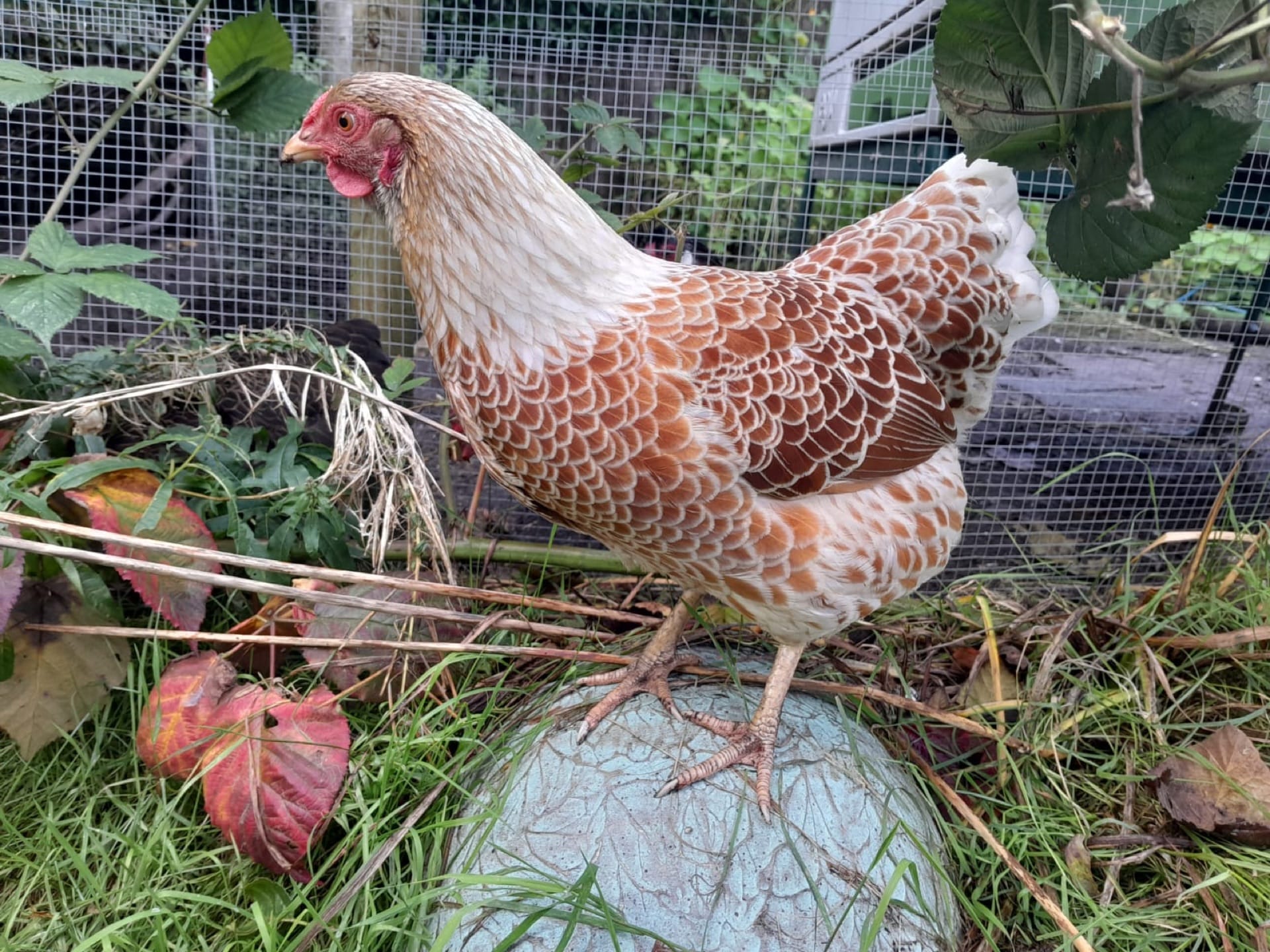
This is a medium to large bird with a solid, rectangular outline often described as "brick-shaped": a long, broad, level body carried low and horizontal. The standard breed is a heavy, soft-feathered fowl with real substance in the hand.
The colour is the giveaway. Plumage runs from a rich, lustrous mahogany-red through to a deep rusty red, and in some birds almost to black, with a mostly black tail that can carry a green sheen. The legs and feet are yellow, the beak reddish-horn, and the face, single comb, wattles and earlobes are all bright red. A rose-comb version also exists, but the single comb is far more common in gardens. It is a handsome, workmanlike bird rather than a fussy show breed, which is exactly what its creators intended.
What is their temperament like?
Rhode Island Red hens are generally friendly, active and inquisitive. They are confident foragers that enjoy human company, settle to handling well, and rarely turn nervous. That steadiness is a big part of why they suit first-time keepers.
They do have a stronger personality than some. In a mixed flock a Rhode Island Red will often push towards the top of the pecking order, and they can be more assertive or dominant than a placid breed such as the Orpington or the easy-going Sussex. This is manageable with enough space and sensible flock introductions, but it is worth knowing before you mix them with very gentle birds.
The bigger caution is with males. Rhode Island Red cockerels have a reputation for aggression, and while individual temperament varies, some do become difficult towards people, especially in the breeding season. Most garden keepers do not need a cockerel at all, since hens lay perfectly well without one, so unless you plan to breed, hens are the simpler and safer choice.
How many eggs do Rhode Island Reds lay?
This is where the breed shines. A good Rhode Island Red is a genuinely dependable layer, and the traditional "old-type" bird lays somewhere in the region of 200 to 300 brown eggs a year. Treat that as an approximate range rather than a guarantee, because output depends strongly on the strain, the bird's age, diet, and the time of year.
The eggs are usually large and mid-brown, and one of the breed's real virtues is that it keeps laying fairly reliably, including through the shorter, colder days when many breeds tail off. Among the classic dual-purpose breeds, the Rhode Island Red is often rated the best brown-egg layer of the lot.
One important distinction: utility strains, bred for production, will out-lay show or exhibition strains, which have been selected more for appearance than output. If eggs are your priority, ask specifically for laying-bred stock.
Utility, heritage, and the hybrid question
The Rhode Island Red today really exists in a few forms, and it pays to know which you are buying.
At one end sits the productive utility bird and the commercial hybrids derived from it. Many chickens sold cheaply at point of lay as "Rhode Island Reds" are in fact RIR-derived hybrids, not the pure standard breed. They are superb layers and perfectly good garden hens, but they are crosses selected for output, not registered breed birds.
At the other end are the pure, standard-bred heritage lines kept by breed enthusiasts. These are far scarcer than the hybrids. The traditional, non-industrial Rhode Island Red was a conservation concern for years, and only graduated from The Livestock Conservancy's priority list in 2023, a sign the pure bird had recovered but is still nothing like as common as its countless hybrid descendants. If you want the true breed, whether for showing, breeding, or simply to help keep the old lines going, seek out a specialist breeder rather than a general point-of-lay supplier, and expect to pay more.
Are they hardy enough for the UK climate?
Yes. Hardiness is one of the breed's defining traits, and Rhode Island Reds cope well with cold and generally stand up to the damp, changeable British weather better than many. Their willingness to keep laying through winter is part of the same toughness.
The main weather weak point is the single comb, which can be prone to frostbite in a hard frost. A dry, draught-free coop with good ventilation (still air, not a through-draught) sees them comfortably through winter. As with any breed, keep the run from becoming waterlogged, because persistent mud causes far more health trouble in a British winter than the cold itself.
How should you house and care for them?
Rhode Island Reds are active, keen foragers, so they are happiest with room to move rather than confined to a cramped run. Give them space to scratch about and they will reward you with steady laying and contented behaviour.
- 1
Secure, fox-proof housing
Foxes are the single biggest threat to UK garden hens, in towns as much as the countryside. Use a sturdy coop and a run with weld mesh (not flimsy chicken wire), skirted or dug in at the base, and shut the birds in securely every night.
- 2
Space to forage
As an active breed, they need more room than a placid bird to stay fit and out of mischief. A generous run, or safe supervised free ranging, keeps them healthy and cuts down on squabbling.
- 3
Dry, ventilated shelter
Provide a weatherproof coop that stays dry and draught-free but is well ventilated, with enough perch space and clean, dry bedding to protect that single comb in cold weather.
- 4
Fresh water, good feed and grit
Give constant access to clean water and a complete layers ration, plus hard grit so they can digest food properly. Heavy layers need the nutrition to keep production up.
- 5
Company
Chickens are flock birds. Keep at least three hens together so they can behave naturally; a lone hen is an unhappy hen.
Under the Animal Welfare Act 2006, anyone responsible for an animal has a legal duty of care to meet its welfare needs: a suitable environment, a suitable diet, the ability to behave normally, appropriate company, and protection from pain, suffering, injury and disease. For hens, meeting those needs is mostly common sense done consistently. Our chickens hub gathers the housing, feeding and flock-care guides, and the RSPCA's welfare advice is a sound external reference.
What are the legal rules for keeping them?
Beyond general welfare law, there is one specific rule every new keeper must know.
How do they compare to the Sussex and the Orpington?
All three are classic UK-friendly breeds, but they suit slightly different keepers. The Sussex is calm, adaptable and a very good all-rounder, laying well while being a shade gentler in temperament. The Orpington is the softest and most placid of the three: a big, docile, cuddly bird that lays more modestly and prizes friendliness over output.
The Rhode Island Red sits at the productive end. If your first priority is a strong, reliable supply of brown eggs from a hardy, confident bird, it is the pick of the three. If you want maximum tameness or a gentle family pet that also lays, an Orpington or Sussex may suit you better. For many keepers, a small mixed flock of all three gives the best of every world.
Whichever you choose, start with healthy stock from a reputable source, house them properly, and register with APHA. Do that, and a few Rhode Island Reds will keep your kitchen in eggs for years.
Frequently asked questions
Sources
- Register as a keeper of less than 50 poultry or other captive birds , GOV.UK / APHA
- Rhode Island Red , Wikipedia
- Rhode Island Red breed page , The Poultry Club of Great Britain
- Rhode Island Red , The Livestock Conservancy
- Keeping chickens as pets: how to care for backyard hens , RSPCA
Kit for this job (Ad)

FeelGoodUK Coop House Chicken Coop, Large
Check price on Amazon →
FeelGoodUK CHICKEN COOP HEN HOUSE POULTRY ARK HOME NEST RUN COUP WITH INTEGRA...
Check price on Amazon →
Cocoon ECO 6002N Chicken Coop – Wooden Hen House with Rot-Proof Plastic Roofs, Pull-Out Tray & Nest Box – Ideal for 4–6 Birds
Check price on Amazon →
Cocoon ECO 1000 Large Chicken Coop – Wooden Hen House with Rot-Proof Plastic Roofs, Dual Pull-Out Trays, Secure Nest Box & Auto Door Ready, Ideal for 6–8 Birds
Check price on Amazon →We may earn a small commission, at no cost to you. We only list kit we'd use.
Written by
UK Homesteading Team
Editorial team
The UK Homesteading editorial team, offering UK-specific, evidence-led guidance on growing, keeping, preserving and the law.