Few chickens turn heads like a Silkie. They look less like a hen and more like a walking powder puff, and they have a temperament to match the soft appearance. If you have read our chickens hub or our roundup of the best chicken breeds for a UK back garden and found yourself drawn to the fluffy one, this guide covers what a Silkie actually is, what it is like to keep, and the few things about our damp British climate that catch new Silkie keepers out.
What is a Silkie chicken?
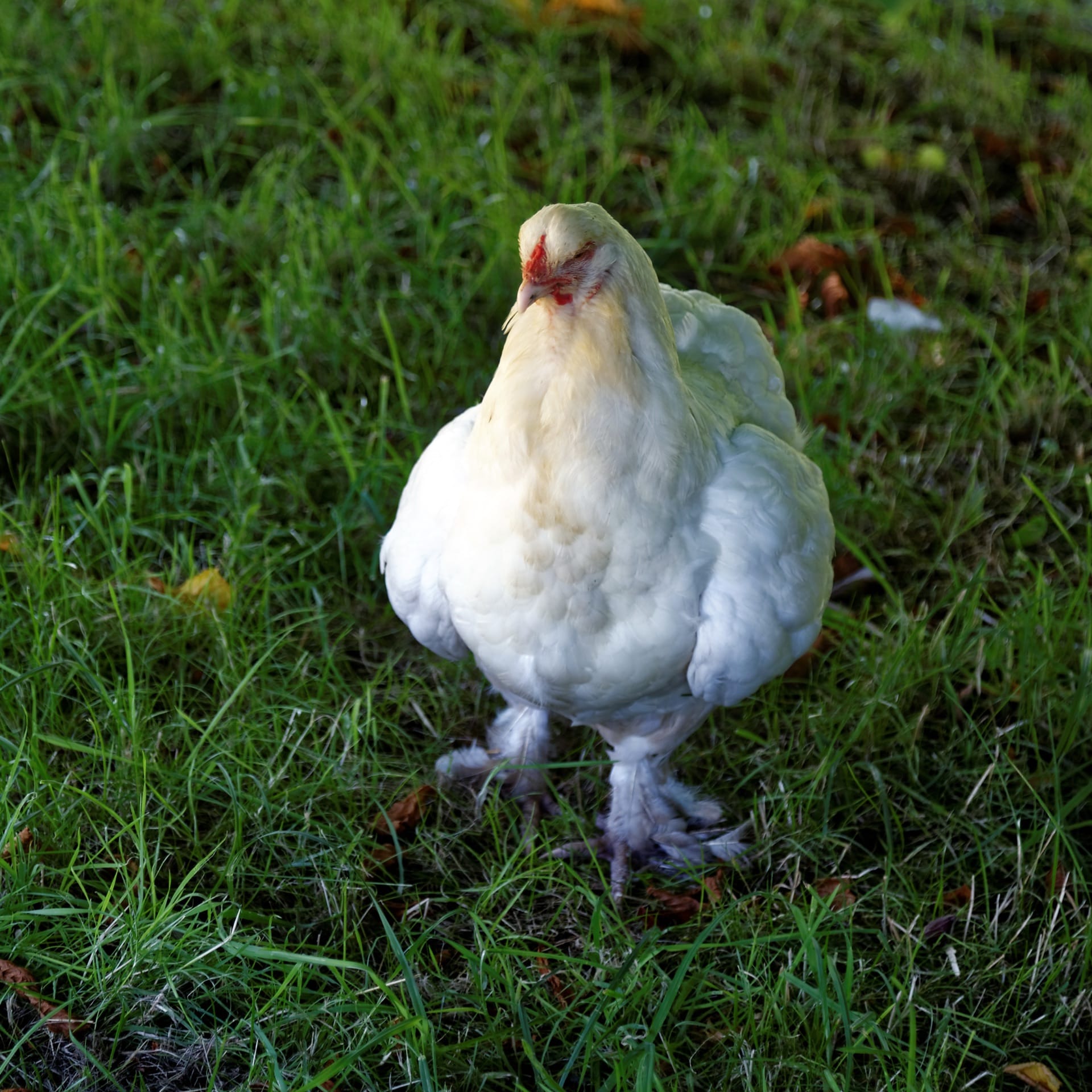
A Silkie is an ornamental breed known first and foremost for its plumage. Ordinary feathers have tiny hooks called barbicels that zip the strands together into a smooth, weatherproof surface. Silkie feathers lack functioning barbicels, so the strands stay loose and open, which is why the bird feels soft as silk or fur rather than sleek like a normal hen. It is a lovely quality to stroke, and it is also the single fact that shapes almost everything about their care.
Under that fluff, Silkies are stranger still. They carry a genetic trait called fibromelanosis, a form of hyperpigmentation that turns their skin, bones and even much of their meat a bluish-black. Most hens have four toes; Silkies have five, a trait called polydactyly. They have feathered legs and feet, a walnut-shaped comb, dark wattles and, unusually, turquoise-blue earlobes. Many also sport a rounded crest of feathers on the head, and a lot of birds have a domed or "vaulted" skull beneath it, a soft opening in the top of the skull rather like the fontanelle on a newborn baby.
They are small birds. In the European standard, cocks weigh around 1.4 to 1.7 kg and hens around 1.1 to 1.4 kg, and bantam Silkies are smaller again. They come in a range of colours including white, black, blue, splash, lavender, buff, grey and partridge.
They look less like a hen and more like a walking powder puff, and the temperament matches the appearance.
What are Silkies like to keep?
This is where Silkies earn their fans. They are famously docile: calm, tame, easy to pick up and happy to be handled. That gentle nature makes them one of the best breeds for children and for anyone who wants a chicken that is as much a pet as a producer. Sit down in the garden and a Silkie will often potter over to see what you are doing.
The flip side of that sweetness is that Silkies sit near the bottom of the pecking order. In a mixed flock they are easily bullied by pushier hybrids, so it is wise to keep at least two Silkies together for company, and to watch how they settle if you introduce them to bolder birds. The RSPCA recommends keeping a small group of hens that get on well rather than a lone bird, and that advice matters even more for a breed this meek.
Do Silkies lay many eggs?
Set your expectations here before you buy. A Silkie is a modest layer, producing roughly 100 to 120 small cream eggs a year, which works out at about two or three a week in a good spell. Laying is also frequently interrupted, because Silkies go broody at the drop of a hat.
If your main goal is a full egg basket, a Silkie is not the bird for the job, and there is no shame in saying so. They are kept as pets, as show birds and as broody hens. Plenty of keepers run a couple of Silkies alongside a more productive hybrid: the hybrid fills the egg carton and the Silkie provides the charm and, when you want it, the incubation service.
Why are Silkies the classic broody hen?
Broodiness is the Silkie's superpower. The breed has a famously strong tendency to go broody, to sit tight on a clutch and to raise chicks with real dedication. Keepers across the world exploit this by slipping other birds' eggs under a sitting Silkie, and she will happily hatch and mother them, whether they are from another breed of hen or even ducks and other poultry.
For anyone who wants to hatch their own birds without buying an incubator, a reliable broody Silkie is worth her weight in gold. She does the temperature control, the egg turning and the chick rearing for you. It is one of the main reasons experienced keepers keep a Silkie or two on hand even when they lay very little themselves. If you would rather hatch in a machine, our guide to incubating and hatching eggs covers that route.
Can Silkies cope with the British weather?
Here is the fact that trips up new Silkie keepers, so it is worth being blunt about it.
In practice that means a good coop that keeps rain out, plenty of dry bedding, and ideally a covered or partly roofed run so they can be outside in a British downpour without getting drenched. A well-drained patch of ground matters too, because their feathered feet act like little mops and pick up every bit of mud going.
There is an upside to their build. Silkies cannot fly, thanks to those unhooked feathers, so fencing them in is far easier than with a flighty breed: a modest boundary keeps them where you want them. The trade-off is that a bird which cannot fly also cannot flee. Silkies are more vulnerable to foxes, cats and birds of prey than a hen that can flap up out of danger, so a secure, predator-proof run is not optional. Their crest can also grow long enough to hang over the eyes and block their vision, which makes them slower to spot a threat, so keep an eye on it and trim the crest gently if it is obscuring their sight.
What health problems do Silkies have?
Silkies are generally hardy little birds, but a few breed-specific quirks are worth knowing.
The most important is Marek's disease, a common poultry herpesvirus that causes tumours and paralysis. Silkies are unusually susceptible to it compared with many other breeds, and there is no cure once a bird shows signs. The sensible protection is to buy chicks that have been vaccinated against Marek's at the hatchery, or to source from a breeder who vaccinates, and to ask the question before you buy.
Their feathered feet are the second thing to watch. All that leg feathering is a cosy home for scaly leg mite, a parasite that burrows under the leg scales and leaves them crusty and raised, and the feathers also trap mud that can lead to infections. Check their legs and feet regularly, keep the feathering clean and trim muddy clumps, and treat any scaly leg mite promptly.
Finally, that vaulted skull. In birds that have one, the top of the skull is softer and less protected than normal, so a well-aimed peck from a flock-mate, or a knock, can do far more damage than it would to another hen. It is another reason to keep gentle flock company and to handle crested, domed-skull birds carefully around the head.
Do Silkies suit a UK back garden?
For a lot of people, yes, and happily so. They are small, they cannot fly out of a modest run, they are wonderful with children and they are about as friendly as a chicken gets. If you want a productive laying flock they are the wrong choice, but as pets, as broodies or as the character in a mixed flock, they are hard to beat.
Go in with clear eyes: they ask for dry housing, a run that does not turn to soup in autumn and winter, a bit of grooming for those feathery feet and crest, secure protection from predators, and a Marek's vaccination to start life. Give them that and you get one of the most rewarding birds in the poultry world.
Whatever chicken you keep, remember the legal duty of care. Under the Animal Welfare Act 2006, anyone responsible for an animal must meet its welfare needs, including a suitable environment and protection from pain, suffering, injury and disease. For a Silkie, "suitable environment" specifically means dry and sheltered.
Registering your Silkies
Before your birds arrive, sort out registration.
- 1
Register your birds first
Sign up before or as soon as your birds arrive, on the gov.uk poultry register in England and Wales, the Scottish Kept Bird Register in Scotland or with DAERA in Northern Ireland. It is free, quick and a legal requirement for all keepers.
- 2
Set up dry, secure housing
Provide a rain-proof, draught-free coop with dry bedding, a covered or well-drained run, and a predator-proof boundary, since Silkies cannot fly to escape danger.
- 3
Buy vaccinated stock
Source chicks or birds that have been vaccinated against Marek's disease, or ask the breeder about their vaccination policy before you commit.
- 4
Keep at least two together
Silkies sit low in the pecking order, so give them a companion and watch introductions to any bolder hybrids.
- 5
Groom and health-check regularly
Trim an overgrown crest so they can see, check and clean the feathered feet for mud and scaly leg mite, and handle domed-skull birds gently around the head.
Once your Silkies are settled, browse the rest of our chickens hub for coop, feeding and flock-management guides, and see how they compare in our best chicken breeds for a UK back garden roundup.
Frequently asked questions
Sources
Kit for this job (Ad)

FeelGoodUK Coop House Chicken Coop, Large
Check price on Amazon →
FeelGoodUK CHICKEN COOP HEN HOUSE POULTRY ARK HOME NEST RUN COUP WITH INTEGRA...
Check price on Amazon →
Cocoon ECO 6002N Chicken Coop – Wooden Hen House with Rot-Proof Plastic Roofs, Pull-Out Tray & Nest Box – Ideal for 4–6 Birds
Check price on Amazon →
Cocoon ECO 1000 Large Chicken Coop – Wooden Hen House with Rot-Proof Plastic Roofs, Dual Pull-Out Trays, Secure Nest Box & Auto Door Ready, Ideal for 6–8 Birds
Check price on Amazon →We may earn a small commission, at no cost to you. We only list kit we'd use.
Written by
UK Homesteading Team
Editorial team
The UK Homesteading editorial team, offering UK-specific, evidence-led guidance on growing, keeping, preserving and the law.