Harvesting is the part of the beekeeping year everyone pictures when they first think about keeping bees: lifting off a heavy super, uncapping golden comb, and watching honey run out of the extractor. It is genuinely one of the most satisfying jobs on a smallholding. But a good harvest is as much about restraint as reward. You take only the ripe surplus, you leave the colony enough to survive the winter, and, the moment money changes hands, you step into food law. Get those three things right and the rest is just pleasant, sticky work.
This guide picks up where our beginner's guide to keeping bees leaves off, and assumes you already have the equipment and a working hive. It walks through when to take honey off, how much to leave the bees, and how to clear, extract, filter, jar and store it, before the legal bit that only bites if you sell.
When to harvest: wait for capped, ripe honey
In most of the UK there are two main nectar flows and, in some areas, a later heather flow. The first runs from about mid-April to the end of May (oilseed rape, fruit trees, hawthorn, sycamore), the second and usually the biggest from mid-June into early August (lime, clover, blackberry, willowherb), and heather comes in August and September. The main honey harvest, for most keepers, is at the end of that summer flow, so roughly late July through September.
The calendar matters less than ripeness. Bees take in watery nectar and dry it down inside the comb until the water content is around 17 per cent, then they seal each cell with a thin wax cap. That capping is your green light. As the BBKA puts it, capped honey can keep almost indefinitely, whereas honey extracted too wet will ferment. So harvest at the end of a flow, and if the frames are not yet fully capped, wait a week or so and check again.
Leave enough for the bees
This is the welfare heart of harvesting, and it is not optional. A colony overwinters as a living cluster, not in hibernation, and it eats its way through its stores to stay warm until spring. Take too much and you condemn it to starve or leave it dependent on you. The whole idea is that you harvest only the surplus a strong colony makes above its own needs, which in a good year can be two to three times what it will use.
How much is enough? The National Bee Unit advises a colony needs roughly 18 to 22 kg of stores to get through winter. A full brood frame holds about 1.2 kg of honey, which gives you a way to weigh up a hive frame by frame or by hefting it. The BBKA frames it slightly differently, noting a hive needs only about 20 to 30 lb of honey for an average winter, but either way the principle is the same: leave the bees a proper larder before you count what is yours.
Clearing the bees off the supers
Before you can extract anything you need honey supers with the honey in and the bees out. There are three common ways to part the two.
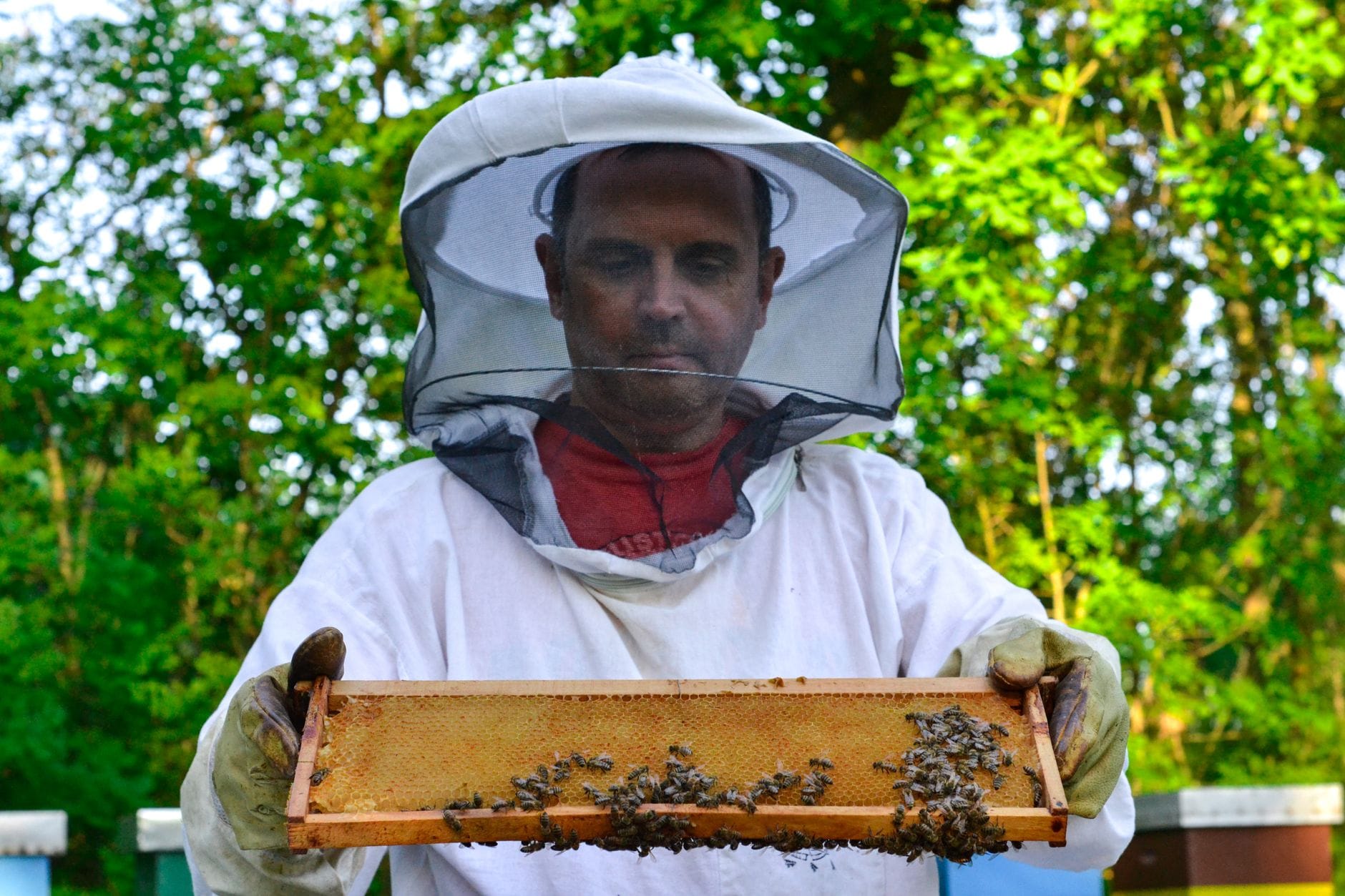
- Clearer board (the usual choice). A clearer board carries one or more one-way bee escapes, often Porter escapes or a spiral or rhombus design. You place it under the supers you want, above the queen excluder, and over a day or two the bees walk down into the brood box and cannot get back up. Come back and the supers are largely empty, with maybe a few stragglers to brush off.
- Brushing frame by frame. You can lift each frame and brush or shake the bees back into the hive with a soft bee brush, standing the cleared frames in a spare covered super. It works for a weak or small colony but is slow and provoking with a busy hive.
- Bee repellent. A proprietary repellent on a special board drives the bees down out of the super. Follow the product instructions exactly if you use one.
Whichever you use, leave the bees room. If you are clearing three supers down into the brood box, that is a lot of bees suddenly crowded, so leave them a super of stores or foundation to spread into rather than jamming them in.
Extracting: uncapping, then spinning or crushing
Warm honey flows; cold honey fights you. The comfortable working range for uncapping and extracting is about 21 to 27°C. Below roughly 18°C the honey is stiff and hard work, and above about 32°C the wax goes too soft to handle. If your extracting room is cold, many keepers warm the supers gently for a day or two before starting.
There are two main routes from comb to bucket, and the right one depends on your kit.
| Extractor (spinner) | Crush and strain |
|---|---|
| Best for framed hives (National, Langstroth) with drawn comb you want to reuse | Best for top-bar and warre hives, or a first tiny harvest with no extractor |
| Comb survives and goes back to the bees to refill, saving them huge effort | Comb is destroyed; bees must draw fresh wax next time |
| Needs an extractor (borrow from an association before buying) | Needs only a bucket, a sieve and something to crush with |
| Higher yield of clean liquid honey | Lower yield, more wax in the honey, but very simple |
For a framed hive the classic method is to uncap and spin. Extractors come in two types worth knowing: tangential, where the frame faces flat against the drum and you spin one side, flip it, and spin the other; and radial, where frames sit like spokes of a wheel and both sides empty at once. Tangential extractors are cheaper and common for hobby use; radial ones are faster for bigger harvests.
Extracting your honey step by step
- 1
Uncap the comb
Over an uncapping tray or a bucket with a straining tray, slice the thin wax cappings off both faces of each frame with a serrated knife or an uncapping fork. A plain bread knife is fine; some keepers avoid electrically heated knives, which can overheat and dull the flavour. Save the cappings, as they hold honey you can drain off.
- 2
Load the extractor
Put the uncapped frames into the extractor, balanced so the machine does not lurch. In a tangential extractor, put the frames in facing the drum wall. Start spinning slowly and build up speed gradually, or the comb can blow out.
- 3
Spin it out
Honey flings against the drum and runs down to the bottom. In a tangential machine, spin one side part way, turn every frame around, spin the other side fully, then finish the first side. It looks like little is coming out at first, then the tank fills fast.
- 4
Drain into a bucket or tank
Open the honey gate at the base and run the honey out through a coarse strainer into a clean food-grade bucket or settling tank. Keep the extractor spinning empty for a moment between batches so it drains.
- 5
Give the wet comb and cappings back
Once you have finished, let the bees clean up. Put the emptied wet supers and the drained cappings out for the colony (a feeder tray works well) and they will lick every trace clean within days, ready for storage.
Filtering and settling
Straight out of the extractor, honey carries bits of wax, the odd leg and air bubbles. Pour it through a honey strainer or a double sieve (coarse then fine) into a settling tank or bucket, then leave it to stand for about 24 hours in a warm room. Wax specks, froth and fine debris rise to the surface as a pale scum, which you skim off the top. Do not over-filter at home: pushing honey through very fine filters, especially under heat, can strip out the natural pollen, which for honey you sell is actually forbidden. A simple sieve keeps the honey clean while leaving it as honey should be.
Jarring and storing
Jar into clean, dry, food-safe glass jars with sound lids. A settling tank with a honey gate at the bottom makes this easy and tidy, and standing the jar on a small digital scale lets you hit the weight you want. Wipe any drips, cap firmly, and label.
Stored somewhere cool and dark, honey keeps almost indefinitely; comb from the Egyptian tombs was still honey thousands of years on. What it will do is crystallise. That is natural: honey is supersaturated sugar, and the glucose slowly forms crystals so a runny jar turns thick and grainy. Oilseed rape honey sets famously fast and hard; garden-flower honey often stays clear for months. Crystallised honey is perfectly good. To re-liquefy it, stand the jar in a bowl of warm (not hot) water and let it soften slowly.
If you sell it: the honey label law
Everything above is yours to do as you please while the honey stays in your own kitchen. The rules switch on the moment you sell, even a handful of jars at the gate or a market stall, because that makes you a food business.
Two extra points catch beekeepers out. First, honey sold loose or "prepacked for direct sale" (jarred by you and sold from your own premises or stall) needs less on the label than fully prepacked honey, but it still needs the name and the country of origin, so do not assume the gate sale is unregulated. Second, be careful with plant names and place names: a jar can only be called "Lavender honey" or "Sussex honey" if the honey genuinely comes wholly or mainly from that source or place. When in doubt, keep the label plain and honest.
This guide is general information for UK beekeepers, not legal advice, and the law referred to is England-first: Wales, Scotland and Northern Ireland have their own honey regulations. Winter-store and moisture figures follow the National Bee Unit and BBKA, but every colony and season differs, so heft your own hives and check the honey before you store or sell it. Always confirm the current labelling and food-business rules with your local council or Trading Standards before selling. Last checked July 2026.
Frequently asked questions
Sources
- Honey (why and how bees make it, harvesting, winter stores) , British Beekeepers Association (BBKA)
- Feeding sugar to bees - Best Practice Guideline No. 7a (winter stores and autumn feeding) , National Bee Unit (Animal and Plant Health Agency)
- Food standards: labelling and composition (Honey section) , Food Standards Agency / Defra (GOV.UK)
- The Honey (England) Regulations 2015 , Legislation.gov.uk
- Labelling of honey (name, origin, durability, lot mark, net quantity) , Business Companion (Chartered Trading Standards Institute)
- Harvesting Honey: when and how to harvest and extract , Talking With Bees
Kit for this job (Ad)

New Bee Hive Smoker Stainless Steel w/Heat Shield Beekeeping Equipment
Check price on Amazon →
Kilner Glass Honey Pot with Dipper 0.4 Litre (400ml) Airtight Storage Jar for Honey Treacle Syrup
Check price on Amazon →
CLEVLI Honey Dispenser – No Drip Glass with Stand – Honey Jar – Clear Glass Honey Container with Dipper 8 Oz – Maple Syrup Dispenser – Honey Pot with Stand – Honey Bottle with Flip Top Lid
Check price on Amazon →
11-Inch Stainless Steel Bee Hive Smoker with 3 Pack Of Smoker Fuel
Check price on Amazon →We may earn a small commission, at no cost to you. We only list kit we'd use.
Written by
UK Homesteading Team
Editorial team
The UK Homesteading editorial team, offering UK-specific, evidence-led guidance on growing, keeping, preserving and the law.