Feeding sheep well is mostly about doing very little, at the right times. Sheep are grazing ruminants built to turn grass into meat, milk and wool, so for a large part of the year good pasture and clean water do almost the whole job. The skill is knowing the handful of moments when grass is not enough, feeding just enough to bridge them, and reading your flock by hand so you are responding to what the sheep actually need rather than to a bag of feed and a bad habit. This guide walks through grass, winter forage, concentrates, condition scoring and minerals, and then the one safety point that matters more than all the rest: copper.
If you are just starting out, read our beginner overview on keeping sheep in the UK alongside this, and see choosing sheep breeds for smallholders, because breed affects both how much a sheep needs and, as you will see below, how sensitive it is to copper.
Grass: the natural staple
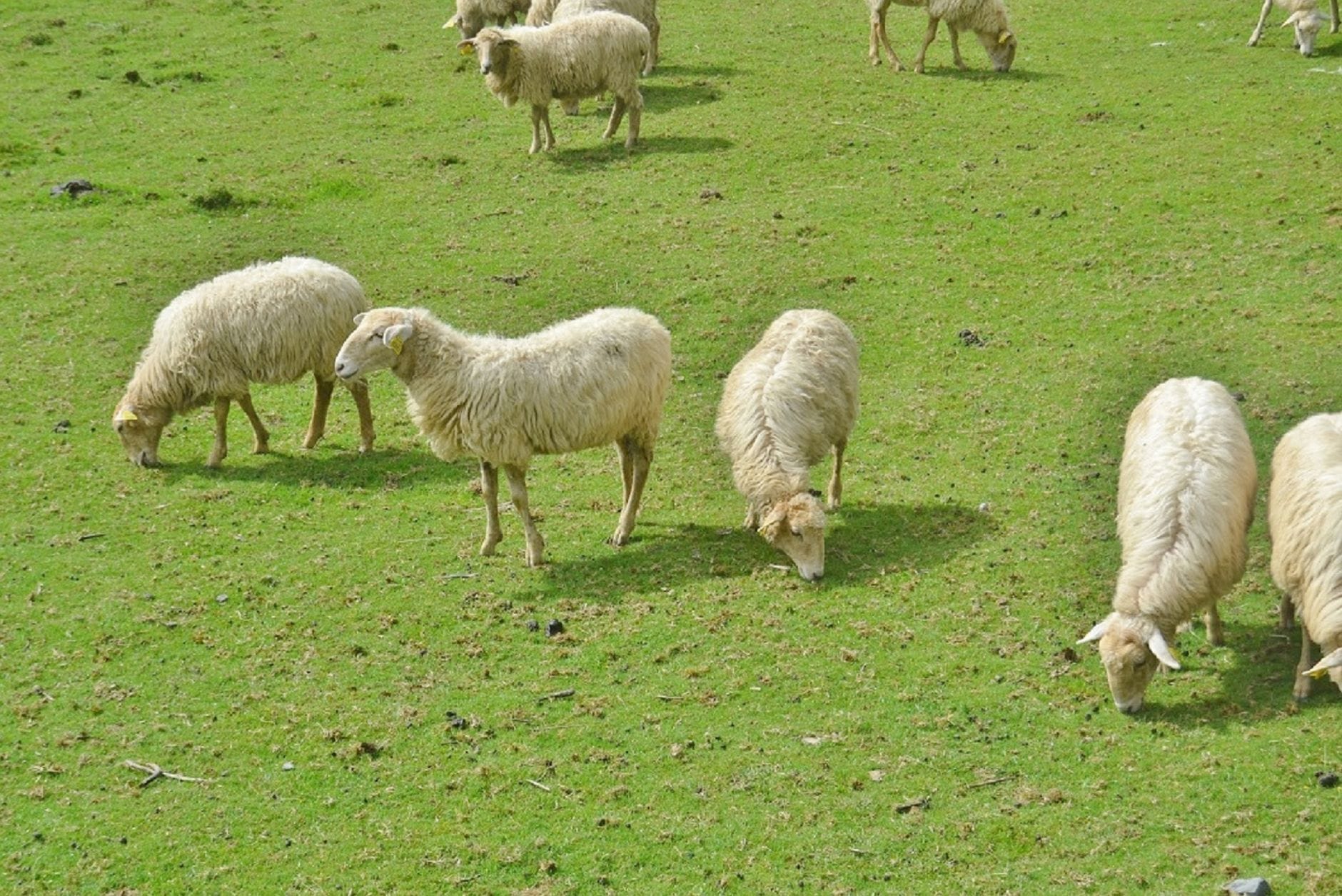
Grass is what sheep are for, and for much of the year it is all a healthy flock at maintenance really needs. In the UK, grass grows when soil temperatures rise, so growth gets going in March or April, surges through late spring and early summer, eases over high summer and picks up again in early autumn before more or less stopping from November to February. Your feeding year is shaped by that curve: a glut of grass in May and June, and a shortage you have to plan for in the dark months.
The single biggest lever on how much your land will carry is not what you buy in bags but how you manage the grazing. Set-stocking, where sheep roam the same field all season, tends to waste grass and build up worm burdens. Rotational grazing, where you move the flock through a series of paddocks and let each one rest and regrow, grows more grass, keeps it leafy and nutritious, and breaks worm cycles by moving stock off contaminated ground. You do not need an elaborate system to start: even splitting one field into three or four temporary paddocks with electric netting and moving every week or two makes a real difference.
Two cautions come with rich grass. First, a sudden move onto lush spring growth can upset rumens, so make changes gradually. Second, that same fast spring grass sits behind grass staggers, covered below. Good grazing is the foundation of cheap, healthy feeding, but it is not quite a complete diet on its own, which is where minerals and winter forage come in.
Hay and silage: bridging the winter
When grass stops growing, you feed conserved forage: hay, or silage (grass cut and preserved wet, often as wrapped bales, sometimes as haylage which sits between the two). This is the winter staple and, for most smallholdings, the workhorse feed from roughly late autumn until spring growth returns.
Good hay is green, smells sweet, and is free of dust and mould. Mouldy or dusty forage causes respiratory problems and can carry the bacteria behind listeriosis, so reject anything that smells sour or musty or that puffs dust when you shake it. Sheep are choosy, and they waste a surprising amount when hay is fed on the ground and trampled, so a rack or ring keeps it clean and cuts waste. Silage and haylage can be excellent, often with more energy than hay, but wrapped bales must be intact: a punctured wrap lets in air and moulds develop, and poorly made silage carries a real listeriosis risk for sheep, so buy from someone who makes it well.
The honest truth about forage is that quality varies enormously, and you cannot tell energy and protein content by looking. If you are feeding ewes through pregnancy, a forage analysis (a cheap lab test on a sample) tells you what you are actually working with and stops you either underfeeding or wastefully overfeeding concentrate on top.
Concentrates: only when there is a real need
Concentrates are the bagged hard feed, usually cereal-based ewe or lamb rations or coarse mixes. They are useful, and they are also the feed smallholders most often overuse. Sheep do not need concentrates as a daily routine, and a fat flock fed cake for the sake of it is both a waste of money and a health risk. Concentrates earn their place in a few specific situations:
- Late pregnancy, roughly the last six to eight weeks, when lambs grow fastest and the growing uterus leaves less room for the ewe to fill up on forage.
- Ewes feeding twins or triplets, whose milk demand outstrips what grass and forage can supply.
- Building condition in a thin ewe, or supporting an old or poor-doing animal that cannot hold its weight on forage alone.
Notice what is not on that list: a healthy single-bearing ewe in good condition on decent grass, or dry ewes over summer, generally need no hard feed at all.
Overfeeding cereals is genuinely dangerous. Too much concentrate in one feed, or a sudden increase, drops the pH in the rumen and causes acidosis, which can range from a scouring, off-colour sheep to a dead one. The veterinary practical advice is to never feed more than about 0.5 kg of concentrate in a single feed, split larger daily amounts into two or more feeds, introduce any hard feed gradually over a week or two, and make sure every sheep can reach trough space so shy animals are not left out while greedy ones gorge. Match the amount to the sheep's needs and your forage quality rather than to a scoop and a routine.
| Grass grazing | Hay / silage | Concentrates |
|---|---|---|
| Natural staple feed | Winter and shortage bridge | Targeted top-up only |
| Spring to early autumn | Late autumn to spring | Late pregnancy, lactation, thin sheep |
| Cheapest, managed by rotation | Bought or made, store dry and clean | Most expensive per kg, easy to overuse |
| Complete at maintenance, plus minerals | Quality varies, analyse for pregnancy | Overfeeding causes acidosis; max ~0.5 kg per feed |
Body condition scoring: how to actually judge feeding
Here is the part that separates good shepherds from anxious ones. You cannot tell whether a sheep is being fed correctly by looking at it, because a full fleece hides both fat and bone. You judge it by feel, using body condition scoring, and it is the most useful five-minute skill you can learn.
Body condition score runs on a five-point scale, from 1 (emaciated, all sharp bone) to 5 (obese, no bone detectable under thick fat), with half scores in between. For most lowland ewes you are aiming for roughly 2.5 to 3.5, tending towards 3 to 3.5 at tupping and not letting ewes slide much below 2.5 to 3 through pregnancy. Hill breeds run a little leaner. The method, following the AHDB Better Returns approach, is to handle the sheep over and around the backbone in the loin, just behind the last rib, and feel how prominent or well covered the vertebrae are.
How to condition score a sheep
- 1
Catch and settle the sheep
Stand or hold the sheep calmly so it is not straining. You are feeling, not looking, so a full fleece is no obstacle.
- 2
Find the loin behind the last rib
Place your hand on the backbone in the loin area, just behind the last rib and in front of the hip bones.
- 3
Feel the spine (the vertical processes)
Press over the top of the backbone. Sharp, prominent, easily felt bones mean a low score; smooth, rounded, hard-to-find bones mean a higher score.
- 4
Feel the tips of the ribs (the horizontal processes)
Press your fingertips under the ends of the short bones sticking out sideways. If they are sharp and you can push under them easily, the sheep is thin; if they are well covered and hard to find, it is well conditioned.
- 5
Assess the loin muscle and fat cover
Feel the depth and fat covering of the muscle in the loin eye. Combine spine, rib-ends and muscle into a single score from 1 to 5, using half scores such as 2.5 or 3.5.
- 6
Score a sample regularly
Condition score a random sample of about one in ten of the flock every few weeks, especially before tupping, at scanning and before lambing, and adjust feeding to move the average towards your target.
Minerals, and the copper warning in full
Grass and forage do not always supply every trace element sheep need, and UK pastures are commonly short of elements such as cobalt, selenium and iodine, with needs rising around breeding and lactation. The usual answer is free-access minerals made for sheep: loose minerals, licks or buckets that the flock can help themselves to. Provide these alongside constant fresh, clean water, which sheep need year-round and in large amounts when milking.
Now the point that this whole page is built around. Sheep are uniquely bad at excreting copper. It accumulates in the liver over weeks or months, often with no outward sign, until the store is overwhelmed and copper releases into the blood in a sudden, usually fatal, wave, causing jaundice, dark red urine and collapse. NADIS reports that these cases are "common during the late summer in pedigree Bluefaced Leicester and Texel ram lambs" fed a lot of concentrate, and notes that breed matters: North Ronaldsay, Texel, Suffolk and several continental short-wool breeds are relatively susceptible, while Cheviots and Scottish Blackfaces tolerate more. Growing lambs absorb copper especially efficiently, so they are at higher risk than adult ewes.
Grass staggers: the spring mineral emergency
The other mineral risk works the opposite way to copper: a sudden shortage, of magnesium, in spring. Grass staggers, or hypomagnesaemia, strikes ewes at peak milk, typically 30 to 40 days after lambing, when they are grazing fast-growing spring grass. Sheep cannot store magnesium and need a constant dietary supply, and lush, heavily fertilised grass, along with the stress of cold wet weather, actually reduces how much magnesium they absorb, just as a milking ewe's demand is highest. The Farm Advisory Service warns that the first sign of staggers "is usually sudden death", which should trigger action to protect the rest of the flock.
If you keep sheep through their first spring after lambing, know the preventatives: offer high-fibre feed such as hay in the field, which slows digestion and improves magnesium absorption and doubles as shelter in bad weather; provide a free-access magnesium source; and avoid heavy potassium fertiliser applications early in the season. If a ewe goes down or you find a sudden death at that time of year, treat it as an emergency and call your vet at once, because affected sheep need prompt magnesium treatment to survive.
Poisonous plants to keep off the menu
Feeding sheep is partly about what you keep away from them. Sheep usually avoid the worst plants when there is plenty of grass, but they eat far less carefully when grazing is short, in winter, or after storms drop leaves and branches into the field. Keep a particular eye out for:
- Rhododendron and its relative Pieris, common garden escapes, whose toxins slow the heart. Poisoning is most likely when snow or bare pasture pushes hungry sheep to browse it.
- Yew, in gardens and churchyards, which can kill very quickly with no time to treat. Fence it off completely and beware branches sagging into reach under snow.
- Oak: acorns and leaves, especially after autumn storms, whose tannins damage the kidneys. Move sheep off heavily acorned ground.
- Ragwort, which damages the liver over time and is most dangerous when it gets into hay or silage, where it stays toxic but loses its bitter taste.
Walk your boundaries and check for garden clippings thrown over the fence, a surprisingly common cause of poisoning, since prunings of yew and rhododendron are lethal. When in doubt about a plant or a poorly sheep, ring your vet.
The feeding mistakes to avoid
- Feeding cattle, goat or general minerals or feed to sheep. This is the classic fatal error: copper builds up and kills.
- Feeding concentrate as a daily routine to sheep that do not need it, leading to fat, unhealthy ewes and lambing problems.
- Increasing hard feed suddenly or feeding large amounts in one go, causing acidosis. Introduce gradually and split feeds.
- Judging condition by eye through the fleece rather than by handling the loin, and so missing thin or over-fat sheep.
- Feeding mouldy hay or badly made silage, risking listeriosis and respiratory disease.
- Ignoring spring grass staggers risk in newly lambed ewes on lush, fertilised pasture.
- Leaving poisonous plants, or garden clippings, within reach, especially when grazing is short.
Get the shape right, plenty of well-managed grass, clean forage through winter, concentrate only when there is a real need, sheep-specific minerals, and a hand run over the loin every few weeks, and you will be feeding your flock both cheaply and safely. For the housing and land side of the same job, see sheep housing and fencing in the UK.
This guide is general information for UK smallholders and is not a substitute for veterinary advice. Rations for pregnant and lactating ewes should be matched to your own forage analysis and flock, ideally with your vet or a nutritionist, and any concern about copper, staggers or suspected poisoning is a same-day call to your vet. Last checked July 2026.
Frequently asked questions
Sources
- Copper Poisoning in Sheep , NADIS (National Animal Disease Information Service)
- Hypomagnesaemia (Staggers) In Sheep , Farm Advisory Service (SAC Consulting / SRUC, funded by the Scottish Government)
- Condition Scoring of Ewes (Better Returns Programme handout) , AHDB Better Returns Programme (EBLEX)
- Managing ewes for better returns , AHDB (Agriculture and Horticulture Development Board)
- Ewes in late pregnancy (feeding and acidosis) , W E Jameson & Son (veterinary practice)
- Four poisonous plants every farmer should be able to spot (rhododendron, ragwort, oak, yew) , Towcester Veterinary Centre
Kit for this job (Ad)

50Pcs 1ml Plastic Syringes With Caps No Needle Colostrum Syringe for Refilling and Measuring Liquids, Scientific Labs, Plant Watering, Pet Feeding ,Glue Applicator
Check price on Amazon →
Premier 1 Supplies ARS 140DXR Japanese Anvil Trimmer, Red, 1.75 Inch Round Point Blade, Ambidextrous, Goat & Sheep Hooves
Check price on Amazon →
Other BURGON & BALL FOOTROT SHEARS SUPERSHARP, Clear, 350 ml, BBL0038
Check price on Amazon →
Kerbl Hay Rack Galvanised Hangs in Cage Bars, 25 x 17 cm
Check price on Amazon →We may earn a small commission, at no cost to you. We only list kit we'd use.
Written by
UK Homesteading Team
Editorial team
The UK Homesteading editorial team, offering UK-specific, evidence-led guidance on growing, keeping, preserving and the law.