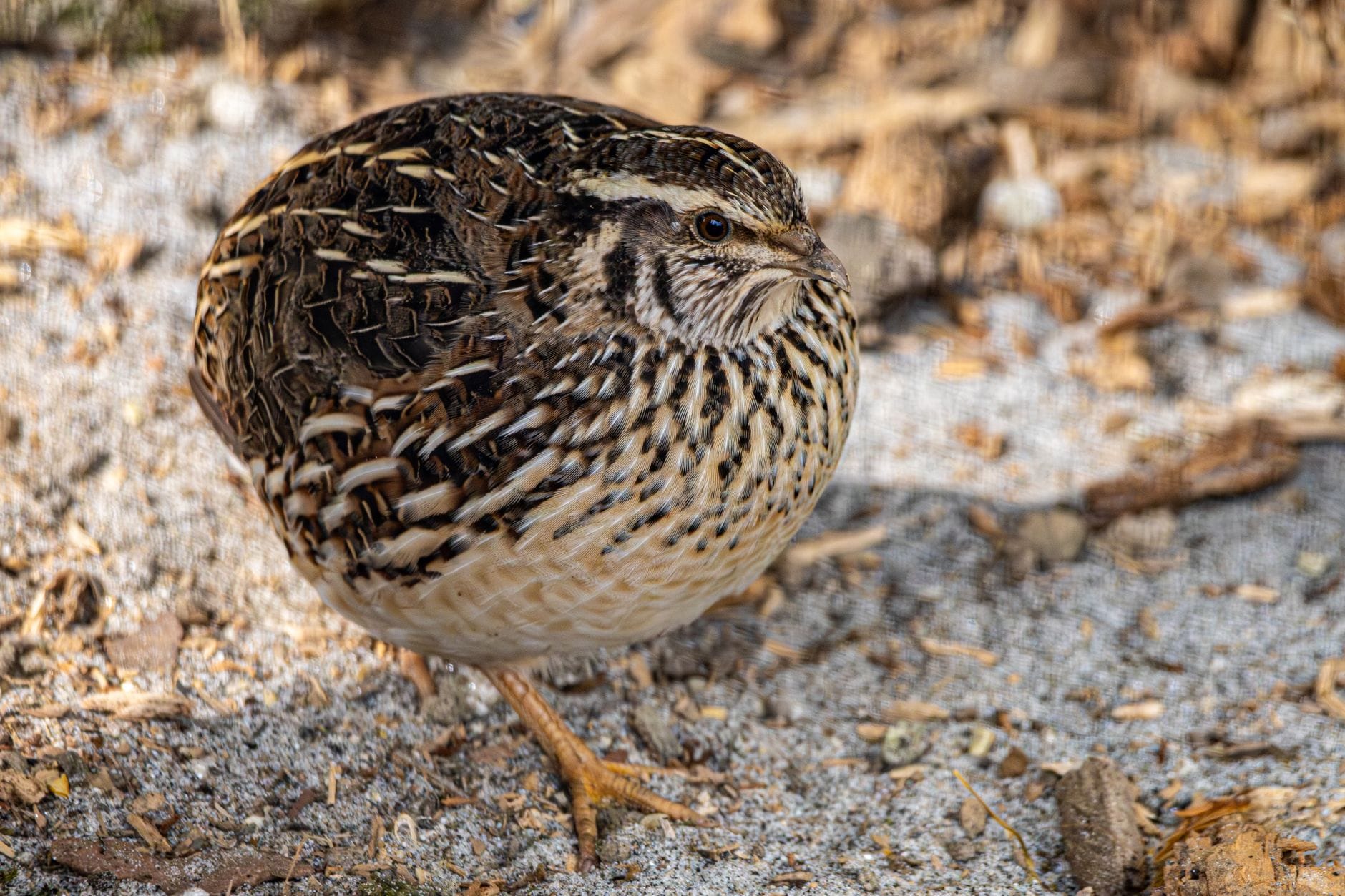
The quickest way to disappoint yourself with quail is to treat them like tiny chickens. They are not. Coturnix quail, the Japanese quail most UK keepers raise for eggs and meat, are compact, fast-growing little birds with a much higher protein requirement than a hen, and beaks far too small for a standard layers pellet. Feed them well and a good strain will lay somewhere around 230 eggs a year, sometimes more with a little winter light. Feed them a bargain bag of chicken pellets and you get thin birds, sluggish laying and, before long, feather pecking. Nearly every feeding problem with quail traces back to the same root: not enough protein, in the wrong shape.
This guide covers what to feed quail at each age, how much, and the bits new keepers most often get wrong, from grit and calcium to the very real risk of a chick drowning in an ordinary water dish. If you are just starting out, read it alongside our beginner's guide to keeping quail and, if you plan to raise your own, hatching quail eggs.
Why quail need more protein than chickens
Quail pack a lot of living into a short time. A chick that fits in a teaspoon at hatching is close to adult weight in around seven weeks and can be laying by eight to twelve weeks. That breakneck growth, followed by heavy egg production from a tiny body, runs on protein. As a rule of thumb, quail need noticeably more of it than chickens at every life stage, which is exactly why standard poultry feeds fall short.
The practical consequence is simple. Ordinary chicken layers pellets are formulated at roughly 16 to 17 per cent protein, which is right for a hen and too low for a quail. Adult quail do best at around 20 per cent, and growing chicks need far more. When the protein runs short, the birds cannot make feathers and eggs properly, so laying drops off and, tellingly, they start pecking and eating each other's feathers, because feathers themselves are mostly protein. If a covey suddenly looks scruffy and bald-patched, low protein is the first thing to check.
| Chick starter (0 to ~5 weeks) | Adult layer / breeder |
|---|---|
| High protein, roughly 24-29% | Moderate protein, roughly 18-20% |
| Fuels very fast early growth | Supports steady egg laying |
| Fine crumb for tiny beaks | Crumb or small 2 mm pellet |
| May contain a coccidiostat (medicated) | Usually unmedicated, higher calcium |
| Fed ad lib, always available | Fed ad lib, plus separate calcium |
The takeaway from that comparison is that "quail feed" is not one product but a short sequence, moving from very high protein down to a laying ration as the bird matures. Get the top end right for chicks and the calcium right for adults, and most other things fall into place.
What to feed quail, by age
Quail feeding follows the same three-step shape as most poultry: a starter, a grower, then an adult ration, just pitched higher on protein and served finer.
A simple quail feeding timeline
- 1
Starter crumb (hatching to about 3 weeks)
Start chicks on a high-protein game or quail starter crumb, around 24 to 29 per cent protein. It must be a fine crumb; whole pellets are too big. Where a quail feed is hard to find, a non-medicated turkey starter crumb is the classic UK stand-in because it is higher in protein than ordinary chick crumb.
- 2
Grower or finisher (about 3 to 6 weeks)
Move gradually onto a grower or finisher of roughly 20 to 24 per cent protein, often sold as a small 2 mm pellet. Birds being raised for the table can stay on this until they reach killing weight.
- 3
Layer or breeder feed (from about 6 weeks, before laying starts)
Introduce a layer or breeder ration of about 18 to 20 per cent protein before the birds come into lay, usually somewhere between 8 and 12 weeks. This feed also carries the extra calcium a laying hen needs.
Change between feeds over a few days rather than overnight, mixing old and new so the birds' digestion keeps up. Keep the transitions unhurried and you will rarely have trouble.
Grit and calcium: two different jobs
New keepers often lump grit and oyster shell together, but they do separate jobs and it is worth understanding both.
Insoluble grit is small, hard stone, and the bird stores it in its gizzard to grind food up, since birds have no teeth. On a soft complete crumb alone a quail can manage without much grit, but the moment you add greens, seeds or any whole grain, grit helps them digest it. A little dish of fine poultry or chick grit, available at all times, covers this.
Oyster shell, cockle shell or limestone chip is a different thing entirely: it is a soluble calcium source, and it exists to give laying hens the raw material for eggshells. A good layer feed already contains calcium, but heavy layers often want more, so offering a separate pot of crushed oyster shell lets each hen top herself up. The tell-tale sign of a shortfall is soft, rubbery or thin-shelled eggs, or hens pecking at anything chalky. Offer grit and oyster shell in their own small containers rather than mixing them into the feed, and let the birds self-select.
Water, and the drowning risk with chicks
Clean, fresh water at all times is non-negotiable for quail of every age. With adults, a shallow drinker or a small poultry founts works fine. With chicks, water becomes a genuine hazard, and it is one of the most common ways people lose day-old quail.
Site the drinker away from where droppings will foul it, refresh it at least daily, and in winter check it has not frozen. Quail are hardy in a UK winter if kept dry and out of draughts, as our housing guide explains, but they still need liquid water every day.
Greens, treats and how much to feed
Quail evolved foraging in rough grass and scrub, so leafy greens are a natural and welcome part of the diet rather than a mere treat. A handful of fresh grass, chopped kale, spinach, dandelion or garden lettuce keeps them busy and happy, and a scatter of mealworms now and then gives a protein-rich bit of enrichment. The key word is moderation: greens and titbits should sit on top of a balanced feed, never replace it, because it is the complete ration that carries the protein and calcium the birds actually depend on.
On quantity, quail are refreshingly low-maintenance. An adult eats only around 15 grams of feed a day, and because they self-regulate and do not gorge, the simplest and safest approach is to keep feed available all the time in a spill-proof feeder. Quail are notorious for flicking feed out of the dish while they root about for favourite morsels, so a feeder with anti-spill fingers, or a deep hopper with a narrow lip, saves a surprising amount of waste over a year.
Common feeding mistakes to avoid
- Feeding standard chicken layers pellets as the main diet. Too low in protein, and physically too big for a quail's beak.
- Buying one bag of feed for all ages. Chicks need far more protein than laying adults; match the feed to the stage.
- Forgetting calcium for laying hens, then wondering why the eggshells are soft.
- Using a deep, open water dish with young chicks. Add pebbles or marbles so they cannot drown.
- Letting treats and greens crowd out the balanced feed, so the birds quietly run short on protein.
- Eating eggs from birds still on medicated starter crumb. Move them onto unmedicated feed and observe the withdrawal period first.
- Feeding kitchen scraps. However well-meant, it is against the law for all poultry.
Get the protein right for the age, keep clean water shallow enough for chicks, and offer grit and calcium on the side, and quail are genuinely one of the easiest and most rewarding little birds to feed. Once feeding is squared away, the next steps are comfortable housing and, if you fancy raising your own, hatching quail eggs.
This guide reflects widely shared UK quail-keeping practice and current GOV.UK feed rules, last checked July 2026. Feed formulations vary between brands, so always read the protein percentage and any medication and withdrawal details on the bag, and check the current GOV.UK guidance before making any decision that touches the law.
Frequently asked questions
Sources
- Beginners Guide to Keeping Quail , Poultry Keeper
- Feeding Quail , Poultry Keeper
- Which Quail food is best for feeding my young Quail and older breeding Quail? , Crowle Quail (Oakwood Game Feeds)
- Quail Feeding Programs , Mississippi State University Extension Service
- Supplying and using animal by-products as farm animal feed , Animal and Plant Health Agency / Defra (GOV.UK)
- APHA warns not to feed kitchen scraps to farm animals because of disease risk , Animal and Plant Health Agency (GOV.UK)
Kit for this job (Ad)

Harrison's High Potency Fine - 454g
Check price on Amazon →
Extra Select Chick Crumbs Complete Chick Feed Tub, 5 Litre, Packaging may vary
Check price on Amazon →
P&T Poultry 1Kg Feeder & 1.5Ltr Drinker For Chickens/Hens/Ducks/Chicks
Check price on Amazon →
P&T Poultry 6ltr Drinker For Chicks / Chickens / Duck / Geese / Quail / Poultry
Check price on Amazon →We may earn a small commission, at no cost to you. We only list kit we'd use.
Written by
UK Homesteading Team
Editorial team
The UK Homesteading editorial team, offering UK-specific, evidence-led guidance on growing, keeping, preserving and the law.