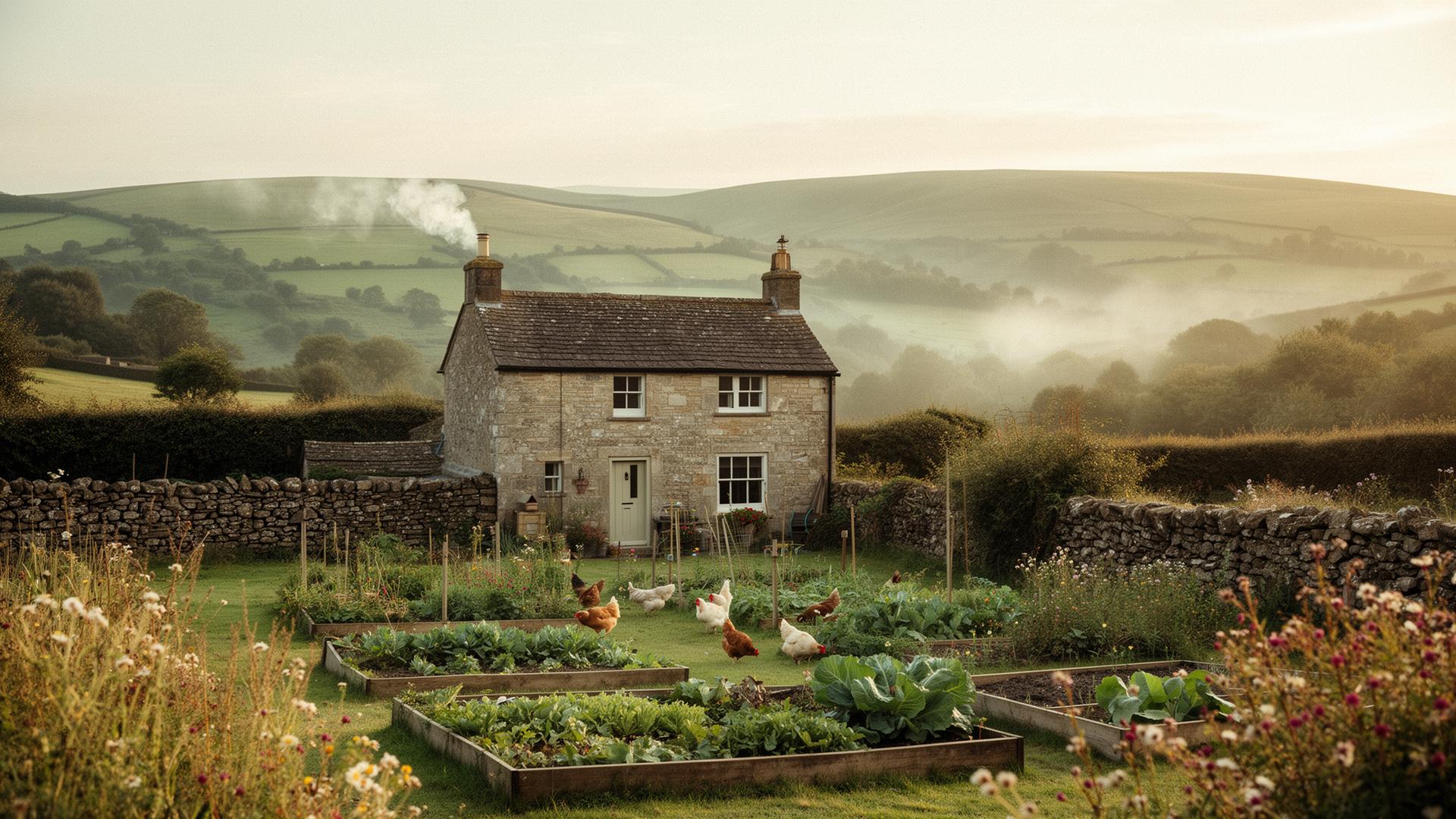
Is buying land in the UK actually realistic?
Yes, but a few home truths first. Land in Britain is expensive and there isn't much of it going, especially anywhere within a comfortable drive of a town. We're a small, crowded island with a planning system built to stop the countryside filling up with houses, and that keeps a lid on supply.
As a rough guide, the average value of farmland across Great Britain was around £8,200 an acre in mid-2025, with prime arable nearer £9,900 and poorer pasture closer to £6,100. Those averages hide a lot, though. A tidy little paddock on the edge of a village, the sort of thing most first-time buyers actually want, will often cost far more per acre than a big open field, partly because there's more demand and partly because of a "small plot" premium. Get anywhere near a city, or find a plot with even a whiff of development potential, and you can multiply the farmland rate several times over.
None of this is meant to put you off. Plenty of ordinary people buy their bit of Britain every year. It's meant to reset the daydream before you start viewing, so you're pricing real fields and not the one in your head.
What's the difference between agricultural land, a paddock and land with a dwelling?
This is the distinction that changes everything, so it's worth getting clear early.
Agricultural land is land whose lawful use is farming. Fields, grazing, arable, the lot. It is, generally speaking, the cheapest land you'll find, and there's a good reason for that: you can farm it, but you cannot live on it or build a house on it as of right.
A paddock is usually just a small parcel of the same thing, often sold for horses, ponies or a bit of grazing. Lovely to own, but the same rules apply. A paddock is not a building plot.
Land with a dwelling, or a plot that already has residential planning permission, is a different animal entirely, and it's priced accordingly. If a house, a cottage or a genuine building plot comes with the land, you're paying for the right to live there, and that right is worth a great deal in this country.
If a listing waves the word "potential" at you, treat it as marketing until a planner tells you otherwise. Potential is not permission.
How much land do you actually need?
Less than the brochures would have you believe. One of the nicest truths about homesteading is that a huge amount can be done on a very small footprint.
Under an acre is plenty to keep a flock of hens, grow a serious amount of vegetables, plant fruit trees and even run a couple of pigs on rotation. It'll keep you thoroughly busy. Around one to two acres gives you room to add more livestock and a bit of breathing space. Three to five acres is the sweet spot a lot of family smallholders settle on: enough for grazing a few sheep or a house cow, hay, orchards and proper rotation, without tipping into full-time farm work.
Beyond five acres or so, you're into more serious pasture management, more machinery and more of your week spent on upkeep. That's a wonderful thing if it's what you want, but you absolutely do not need it to start. Buy for the life you'll actually live, not the one you're imagining on a sunny Sunday.
The land isn't the constraint most beginners think it is. The planning system is. Understand that, and you'll spend your money in the right place.
Can you actually live on land you've bought?
Here's the one that catches nearly everyone.
People do sometimes win permission for a rural dwelling, but the usual route is to prove a genuine, essential agricultural need to live on site, backed by a proper business plan, and councils will frequently grant only a temporary permission first so you can show the enterprise actually stands up over a few years. It is a long, uncertain road, not a formality. Assume you cannot live on bare land unless and until a planning authority says otherwise in writing.
You'll also come across the agricultural occupancy condition, often called an "ag tie". It's a planning restriction stuck to some rural homes saying they can only be lived in by someone mainly employed in agriculture, or their dependents. It keeps the price down but limits who can ever live there, and getting one removed is slow and far from guaranteed. If a cheap-looking country cottage seems too good to be true, check for one of these.
Planning rules also differ across England, Scotland, Wales and Northern Ireland, so guidance you read for one nation may not apply where you're buying. For the wider picture, see our guide to planning permission, and always defer to your local planning authority.
What about putting up buildings, a mobile home or a caravan?
Buildings for genuine farming are treated more kindly than homes, but there are strings.
Agricultural holdings of five hectares (about 12.5 acres) or more have some permitted development rights to erect, extend or alter buildings needed for agriculture, and to carry out certain works, without a full planning application. That sounds generous, but it comes with conditions on size, siting, how close you are to roads and houses, and often a "prior approval" step where the council still gets a say. Crucially, none of it is a back door to a house. Permitted development for farm buildings is for barns, stores and livestock shelter, not somewhere to live.
On plots under five hectares, which is most beginner smallholdings, you'll usually need full planning permission even for modest structures. And a caravan or mobile home you intend to live in is judged on the living, not the wheels. If it's your home, it needs residential permission, full stop. Short, strictly temporary agricultural uses can sometimes sit differently, but "temporary" and "strictly agricultural" are doing heavy lifting in that sentence.
The safe habit is simple: before you build or site anything, ask your local planning authority. It's free to ask and eye-wateringly expensive to guess wrong and face an enforcement notice.
What else can go wrong: access, services and the legal small print?
Bare land is bare in every sense, and the things a house buyer takes for granted may simply not be there.
Access. Can you legally drive onto the plot, or do you only have a right of way on foot? Is there a shared track, and who pays to maintain it? Landlocked parcels, where you can't reach your own field without crossing someone else's, are more common than you'd hope and a nightmare to sort out later.
Services. Mains water, electricity and drainage often stop at the field gate, or nowhere near it. Getting them connected can cost thousands, sometimes tens of thousands, and occasionally isn't possible at all. Many smallholders end up on boreholes, rainwater, solar and off-grid systems by necessity, not just choice.
Public rights of way. A footpath or bridleway crossing your land stays public even though the ground is yours. You can't fence it off or send walkers packing.
Covenants and easements. These are legal conditions buried in the title. A restrictive covenant might ban you from keeping livestock, running a business or putting up buildings, even where planning would otherwise allow it. An easement might give a neighbour or a utility company the right to cross or run pipes through your land. They bind you whether you spotted them or not, which is exactly why you read the title before you buy, not after.
How do you pay for it, and what does it really cost?
The money side has its own quirks. A normal residential mortgage won't touch bare land, so you're generally looking at cash or a specialist agricultural or land mortgage. Those lenders are fewer, tend to want bigger deposits, and will size you up on what the land can lawfully be used for and what it might earn. If you're borrowing, talk to a broker who genuinely knows rural and agricultural lending before you fall for a particular plot.
Then budget for everything that isn't the sticker price: solicitor's fees, survey, the land tax for your nation where it applies (Stamp Duty Land Tax in England and Northern Ireland, Land and Buildings Transaction Tax in Scotland, Land Transaction Tax in Wales), fencing, water, access, and the running costs once you're in. Land near cities and desirable villages carries a premium that has little to do with how good the soil is and everything to do with who else wants it.
- 1
Check the planning history and lawful use
Ask the seller and search the council's planning portal. Confirm the current lawful use, any conditions or an agricultural tie, and whether past applications were refused. Never rely on the words 'potential' or 'scope' in a listing.
- 2
Confirm access and rights of way
Establish a legal right of vehicular access to the plot, not just on foot, and check for public footpaths or bridleways crossing it and who maintains any shared track.
- 3
Investigate services
Find out where mains water, electricity and drainage actually reach, and get rough connection costs in writing. Assume off-grid until proven otherwise.
- 4
Read the title for covenants and easements
Have your solicitor pull the Land Registry title and flag anything that restricts what you can keep, build or do, or any rights others hold over the land.
- 5
Get professional advice before you commit
Instruct a solicitor experienced in rural land, and consider a planning consultant if your plans need permission. A few hundred pounds of advice now beats losing your deposit on a plot you can't use.
None of this is meant to dampen the dream. It's meant to protect it. The people who end up really happy with their patch are almost always the ones who were patient, did the boring checks, and bought the right land rather than the first land. Do that, lean on good professionals, and start browsing our wider homesteading guides to plan what you'll actually do once the field is yours.
This guide is general information, not formal legal, financial, medical or veterinary advice. UK rules, prices and best practice change, and some rules differ across England, Scotland, Wales and Northern Ireland, so always check the current position with the relevant official source (such as gov.uk, the NHS, the FSA, DEFRA or APHA, or the RHS) or a qualified professional before acting. Last checked September 2026.
Frequently asked questions
Sources
Written by
UK Homesteading Team
Editorial team
The UK Homesteading editorial team, offering UK-specific, evidence-led guidance on growing, keeping, preserving and the law.