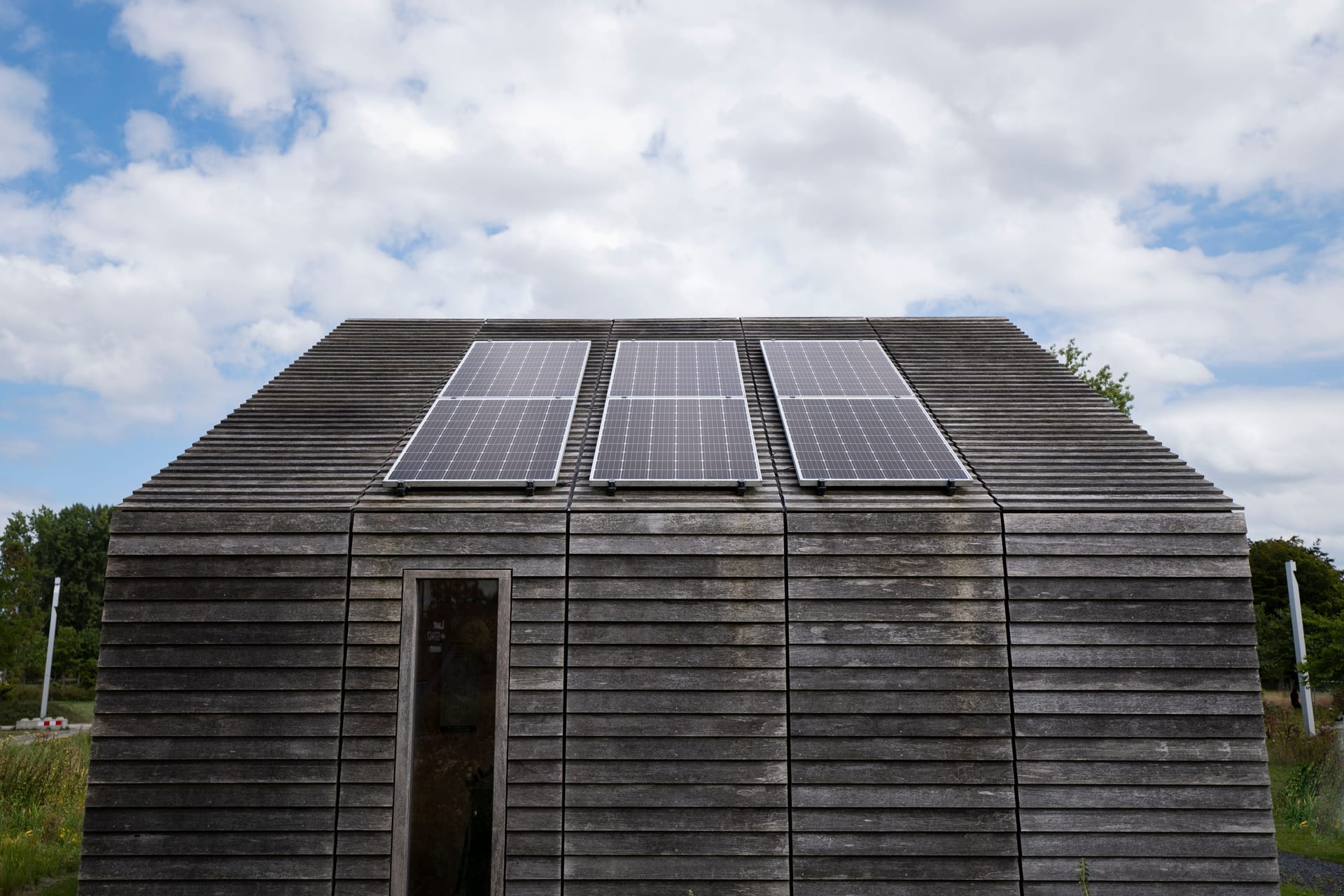
Ask anyone who has lived off-grid through a British winter what the most important part of their system is, and they will not say the solar panels. They will say the batteries. Panels and a wind turbine are only ever generators. It is the battery bank that decides whether you have power at seven in the morning in January, or at nine at night, or on the third grey, still day in a row when nothing much is coming in. The bank is the reservoir the whole household draws from, and in the UK, where the sun is weak and low for months and can hide behind cloud for a week at a time, that reservoir has to be big enough and tough enough to carry you through the gaps.
This guide is about choosing that reservoir well: which battery chemistry to pick, how to work out the size you actually need, what system voltage to build around, and how to wire and house it safely. It pairs with our guides on off-grid solar in the UK and sizing solar panels for the UK climate, because the panels fill the bank and the bank is what you live off. If your site is windy, a small wind turbine can help top it up when the sun is scarce, which in a UK winter is exactly when you need it.
Why the battery bank is the heart of an off-grid system
On the grid, storage is optional. The grid is your infinite battery: you export when you have spare and import when you are short, and you never really run out. Off-grid, there is no import. Everything you use at night, in the early morning, or during a dull spell has to have been captured earlier and held in the bank. That makes the battery the single component that turns intermittent generation into a steady, always-available supply.
This matters more in the UK than almost anywhere. Our winter days are short, the sun sits low, and a solar array that pours out power in June can trickle in December. You can go several days with heavy cloud and barely a useful charge. The battery bank has to bridge those gaps, which is why UK off-grid systems are usually sized for more days of autonomy, and often a proportionally larger bank, than you would see in a sunnier climate. Get the bank right and the rest of the system has room to breathe. Get it wrong and you spend winter running a generator.
Battery chemistry: lithium (LiFePO4) versus lead-acid
Two families of battery dominate off-grid. Lead-acid is the old workhorse, sold as flooded (the traditional type you top up with distilled water), AGM and gel (both sealed, maintenance-free variants). Lithium iron phosphate, written LiFePO4 or LFP, is the modern standard for off-grid: a safer, longer-lived cousin of the lithium in phones and cars.
The headline difference is usable depth of discharge, and it drives almost everything else. You can routinely use around 80 to 100 per cent of a LiFePO4 battery's rated capacity. With lead-acid, you should not go below about 50 per cent state of charge if you want it to last, because deep discharges wear it out quickly. So a nominal 10 kWh lead-acid bank only really gives you about 5 kWh you can use, while a 10 kWh lithium bank gives you 8 to 10 kWh. To store the same usable energy, a lead-acid bank has to be roughly twice the size, and it will be far heavier for it.
| Lithium (LiFePO4) | Lead-acid (flooded / AGM / gel) | |
|---|---|---|
| Usable depth of discharge | ~80-100% | ~50% (going deeper shortens life) |
| Cycle life (typical) | Several thousand cycles; often 10-15 years+ | Few hundred to ~1,000+ cycles; often 3-7 years |
| Weight & size for same usable energy | About half | About double |
| Maintenance | None (sealed, managed by a BMS) | Flooded needs topping up & equalising; AGM/gel are sealed |
| Round-trip efficiency | Higher (less energy lost per cycle) | Lower |
| Cold-weather behaviour | Good, but must not be charged below 0°C without protection | Loses usable capacity in the cold |
| Upfront cost | Higher | Lower |
| Cost per usable cycle over its life | Usually lower | Usually higher |
For most people building a new off-grid bank today, LiFePO4 is the sensible default despite the higher sticker price, because the longer life and deeper usable capacity generally win over the years. Lead-acid still earns its place where the budget is tight up front, for smaller or backup banks, or where you genuinely prefer a simple, forgiving chemistry you can understand at a glance. One lithium caveat worth knowing: LiFePO4 must not be charged when it is below freezing unless it has low-temperature protection built in, so an unheated outbuilding in a hard UK frost needs a battery that handles this.
How to size your battery bank
Sizing is arithmetic, not guesswork, and it is worth doing properly because both undersizing (you run out and reach for the generator) and gross oversizing (you pay for capacity you never cycle) cost you. The method is the same whatever the chemistry.
Sizing your off-grid battery bank
- 1
Add up your real daily use in kWh
Go appliance by appliance, or read it off an energy monitor over a week. Be honest about kettles, fridges, pumps and any electric heating. Call the daily total your daily kWh.
- 2
Choose your days of autonomy
This is how many low-generation days you want the bank alone to cover. In the UK, 2 to 3 days is a common minimum because of grey winter spells; cautious or remote setups plan for more. Multiply daily kWh by days of autonomy to get the usable energy you need to store.
- 3
Divide by usable depth of discharge
Divide that usable figure by your battery's safe depth of discharge: about 0.8-1.0 for LiFePO4, about 0.5 for lead-acid. This turns 'energy I want to use' into 'nominal capacity I must buy'.
- 4
Add an allowance for losses
Inverters and the charge/discharge round trip waste some energy. Add roughly 10 to 20 per cent on top to cover it. The result is your target nominal battery capacity in kWh.
- 5
Convert to your system voltage
Divide the nominal kWh by your system voltage (e.g. 48V) and multiply by 1,000 to get amp-hours (Ah) at that voltage, which is how batteries are often sold. Then round up to real product sizes.
Here is the method with numbers. Take a careful off-grid home using 5 kWh a day and wanting 2 days of autonomy. That is 5 × 2 = 10 kWh of usable energy to store.
For LiFePO4 at 80 per cent usable: 10 ÷ 0.8 = 12.5 kWh, plus ~15 per cent for losses ≈ 14 to 15 kWh nominal. At 48V that is roughly 290 to 310 Ah.
For lead-acid at 50 per cent usable: 10 ÷ 0.5 = 20 kWh, plus ~15 per cent for losses ≈ 23 to 24 kWh nominal - nearly double the lithium bank for the very same job. That size and weight difference is exactly why so many off-grid homes move to lithium.
System voltage: 12V, 24V or 48V
Off-grid banks are built at 12, 24 or 48 volts, and the choice is not just a technicality. The physics is simple: power equals voltage times current (P = V × I). For the same power, a higher system voltage draws a lower current, and lower current means you can use thinner, cheaper cables and lose far less energy as heat in the wiring. Push a big load through a 12V system and the currents get huge, the cables get fat and expensive, and the losses mount.
As a rough guide, 12V suits small systems up to around 1 to 1.5 kW: campervans, a shed, a modest cabin. 24V suits mid-size setups. 48V is the standard for a whole-home off-grid system and is what most serious UK off-grid installs are built around. If there is any chance you are powering a house, plan for 48V from the outset. Moving up in voltage later usually means replacing the batteries, the inverter and the charge controller together, so it is a decision to get right at the design stage.
The charge controller and inverter
Two other boxes sit between your generation and your loads, and both deserve a moment.
The charge controller takes the raw output from the solar panels and charges the battery bank correctly and safely. For off-grid, choose an MPPT (maximum power point tracking) controller rather than the older, cheaper PWM type. An MPPT controller actively converts excess panel voltage into extra charging current and typically harvests noticeably more energy from the same array, which matters most in exactly the weak, low winter light where every watt counts. It also lets you wire panels at a higher voltage, which suits longer cable runs on a smallholding. The controller must be rated for your array's current and voltage with headroom to spare.
The inverter turns the battery's DC into the 230V AC mains your appliances expect. Two things matter: choose a pure sine wave inverter (cheaper modified-sine units can hum, run hot or upset sensitive electronics and some motors), and size it to your peak simultaneous load, not your average, with allowance for the brief surge when motors and pumps start. Many off-grid homes use a combined inverter-charger, which also lets a backup generator charge the bank when generation is poor. Match every component to your chosen system voltage.
Safety: ventilation, fusing, the BMS and fire
A battery bank stores a lot of energy in a small space, and it deserves respect. The safety essentials differ by chemistry.
Lithium (LiFePO4) does not vent hydrogen in normal use, so its ventilation needs are far lower, but it has its own rules. Every lithium bank should have a working battery management system (BMS): the electronics that protect the cells from over-charge, over-discharge, over-current and temperature extremes, and keep the cells balanced. Do not defeat or ignore it.
Fusing and cable sizing matter for every chemistry. A battery bank can deliver enormous current into a short circuit, enough to melt cables and start a fire, so fit correctly rated over-current protection close to the battery on the positive cable. For lithium banks a fast-acting fuse (such as a Class T or ANL type sized to your system) is commonly specified because it can safely interrupt the very high fault currents lithium can produce. Use cable of the correct thickness for the current and keep runs short and tidy.
Beyond that, keep the bank dry, keep it within its temperature range (cool but not freezing for lithium; lead-acid loses capacity in the cold), mount it securely, and site it with fire in mind: on a non-combustible surface, away from bedrooms and escape routes where practical, and within reach of a suitable extinguisher. If any of the electrical work is beyond you, bring in a competent installer. This is one part of an off-grid build where a mistake is expensive or dangerous, not just inconvenient.
Rough UK costs and replacement
Costs move around with size, brand and chemistry, so treat everything here as a ballpark and get real quotes. Lead-acid is cheaper to buy but remember you need roughly twice the nominal capacity for the same usable energy, and it wears out sooner. Lithium (LiFePO4) costs more upfront, typically in the region of several hundred pounds per usable kWh for the batteries alone, but its long cycle life usually makes it cheaper per usable cycle over the years. For a genuine off-grid home the battery bank alone commonly runs from a few thousand pounds up into five figures once you add the inverter and charge controller.
The bank is also the part most likely to need replacing during the life of the system, which is another argument for buying decent quality and sizing it right first time. Budget for an eventual replacement, keep your cells within their limits, and a well-chosen bank should quietly do its job through many UK winters.
This is a practical guide to help you plan and understand an off-grid battery system, not a wiring diagram or electrical-design specification. Battery figures, depth-of-discharge and cost ranges are typical values that vary by product and manufacturer, so always work from your own kit's datasheets. Battery banks store dangerous amounts of energy: follow the manufacturer's instructions and the relevant standards (including IEC/EN 62485-2 for battery-room ventilation), and use a competent installer for the electrical work if you are in any doubt. Last checked July 2026.
Frequently asked questions
Sources
- Lead-acid vs LiFePO4: Off-grid Battery Sizing Guide , Aner (off-grid solar retailer, technical guide)
- How Much Battery Capacity Do You Need for Off-Grid Living , LiTime (LiFePO4 battery manufacturer, technical guide)
- Solar Charge Controller Sizing and How to Choose One (MPPT vs PWM) , Renogy UK
- The Essential Guide to Lithium Battery Fuses: Sizing, Types and Safety , LithiumPro Energy (UK)
- IEC 62485-2 - Safety requirements for secondary batteries and battery installations (stationary lead-acid batteries) , Battery Design (engineering reference)
- Stop Fire Risks: Proper Battery BMS, Fusing and Enclosures , Aner (off-grid solar retailer, technical guide)
Kit for this job (Ad)

Victron Energy SmartSolar MPPT Solar Charge Controller (Bluetooth) - MPPT Charge Controller for Solar Panels - 75V 15 amp 12/24-Volt | Bluetooth Charge Controllers for Solar Panels
Check price on Amazon →
MARBERO Portable Power Station 26,400mAh Backup Power Bank with AC Plug Socket 120W Max Solar Generator with LED USB DC Outputs for Camping Emergency Outdoor Adventure Picnic Fishing Travel RV
Check price on Amazon →
MARBERO Portable Power Station 98Wh with 30W Foldable Solar Panel Included 150W Solar Generator Outdoor Battery with DC Outputs for RV Road Trip Outdoor Adventure Camping Home Outage Emergency
Check price on Amazon →
AIVOLT 1200W Petrol Inverter Generator 4 Stroke Portable Silent Suitcase Generator for Camping, Home Use - True Sine Wave, Super Lightweight, Ultra Quiet
Check price on Amazon →We may earn a small commission, at no cost to you. We only list kit we'd use.
Written by
UK Homesteading Team
Editorial team
The UK Homesteading editorial team, offering UK-specific, evidence-led guidance on growing, keeping, preserving and the law.