Ask "are non-stick pans toxic?" and you'll get a reassuring answer from the industry and most regulators: used properly, a modern pan is safe, the bad chemical was banned years ago, stop worrying. And that answer is largely true. It's also answering a narrower question than the one worth asking. Because "will this exact pan poison tonight's dinner?" is not the same as "is this a sensible thing to cook on for the next thirty years?" Here's the honest, fuller picture, sourced, and we'll be straight with you about what the evidence does and doesn't show.
First, the honest concession
We're not here to frighten you, so let's grant the reassuring case its due, because pretending it's wrong would just make us another scare-site. The non-stick coating on most pans is PTFE, a fluoropolymer. At normal cooking temperatures it is chemically stable, doesn't react with your food, and if a small fleck comes off and you swallow it, it passes straight through you. The chemical that genuinely caused harm, PFOA, was a processing aid used to make the coating, not the coating itself, and it was phased out and then banned in the UK and EU in 2020, so pans made since are PFOA-free. European and US food-safety regulators consider PTFE safe for food contact in normal use, and they're not wrong about that narrow point.
So if you're cooking eggs on a medium heat in an intact pan, you are not being poisoned. Good. Now here's why we'd still get rid of it.
The real problem: these are "forever chemicals", and they're in your water
This is the part the "safe in normal use" answer skips, and it's the strongest reason of all, because it holds true even if you accept that your individual pan is fine. PTFE belongs to a family of thousands of chemicals called PFAS, per- and polyfluoroalkyl substances. Their chemical bonds are among the strongest in nature, so they essentially never break down. That's why they're nicknamed "forever chemicals".
Making and disposing of these coatings has pumped PFAS into the environment on a vast scale, and they are now found in the blood of nearly everyone, in wildlife, and in drinking water around the world. The problem is serious enough that in 2024 the US Environmental Protection Agency set its first enforceable drinking-water limits for two of the most-studied PFAS at just 4 parts per trillion, about the lowest level that can reliably be measured. The UK, by contrast, has no hard legal limit for PFAS in drinking water at all, only a guidance level, a gap the Royal Society of Chemistry is publicly campaigning to close. And the European Food Safety Authority has found that parts of the population already take in more PFAS than is considered safe, mostly through contaminated food and water.
This is the honest heart of the "credible challenger" case: even where the argument that a carefully-used pan harms the eater is weak, the environmental and precautionary argument stands firmly on its own.
An overheated pan gives off fumes, and kills birds
Here's a failure mode traditional pans simply don't have. Heat a PTFE coating past roughly 250C and it begins to break down, releasing ultrafine particles and toxic gases. In people this can cause a temporary flu-like illness that doctors call "polymer fume fever". In pet birds, whose lungs are exquisitely sensitive, the same fumes are frequently fatal, a documented condition vets call Teflon toxicosis, with recorded cases of birds dying within half an hour of a pan overheating elsewhere in the house.
And reaching those temperatures is not exotic. An empty non-stick pan preheated on a high hob can climb past 250C within a few minutes; in one test by the campaign group EWG, an empty pan reached about 390C in around three minutes, and was still climbing when the test stopped. Preheating a dry pan, high-heat searing, or simply forgetting a pan on the hob are ordinary kitchen events, not freak accidents. A cast-iron pan in the same situation just gets very hot; it doesn't gas your kitchen.
It wears out, into your food
Non-stick is, by design, a disposable surface. It scratches, wears and eventually flakes, and when it does, the fragments go into your food. Because PTFE is a plastic, those fragments are micro and nano-plastics. A 2022 peer-reviewed study estimated that a single scratch in a coating could release in the region of 9,100 plastic particles, and a badly broken one far more.
We'll be honest about the limits of that: those numbers are modelled estimates, not particles counted in a real dinner, and the specific health effects of swallowing PTFE particles are not established, so we're not going to tell you they make you ill. But the plain point stands on its own. A coating that visibly degrades into your meal has failed at its one job, and the whole model, cook, scratch, replace, is the opposite of the buy-it-for-life approach a homestead kitchen is built on.
What about PFOA and cancer?
This deserves a straight answer, because it's where scare-sites overreach and lose people. In 2023 the World Health Organization's cancer agency, IARC, classified PFOA as a Group 1 carcinogen, "carcinogenic to humans", its highest certainty category. A large study of a community heavily exposed to PFOA near a US chemical plant, the C8 Science Panel, found probable links to high cholesterol, thyroid disease, ulcerative colitis, pregnancy hypertension, and kidney and testicular cancer.
That sounds alarming, and it matters, but here's the honest framing. PFOA is the manufacturing chemical, not the coating, and it was banned in 2020, so it is not in your modern pan. The community findings came from very high, sustained exposure, not from cooking. So this is a real and serious story about industrial pollution and a chemical that lingers in the environment and in our bodies, not evidence that frying an egg gives you cancer. We won't blur that line, because the moment we do, you'd be right to stop trusting us. The legitimate takeaway is about the wider PFAS problem, and one more reason not to keep buying into it.
Isn't ceramic the safe swap?
Tempting, but don't just trade one disposable coating for another. Ceramic (sol-gel) non-stick is genuinely free of PTFE and PFOA, which is a real plus. The snags are that it wears out fast, often losing its non-stick within months to a couple of years, so you're replacing pans even sooner, and that "PFAS-free" claims aren't always independently verified. The wording that actually matters is "fluorine-free", ideally third-party tested. Ceramic can be a fine pan to own, but it isn't the answer to disposability, because it's still a coating that wears out and goes to landfill.
What we'd actually cook on
If you want cookware that never shed, never off-gasses and never needs replacing, the answer is uncoated metal. Here's the honest comparison.
| Material | Why we rate it | The honest trade-off |
|---|---|---|
| Cast iron | Near-indestructible, lasts generations, superb heat retention, builds its own natural non-stick, very cheap per decade | Heavy; needs seasoning and dry storage or it rusts; slow and uneven to heat |
| Carbon steel | Lighter than cast iron and heats faster, also seasons to non-stick, the professional kitchen standard, very durable | Same seasoning and rust care as cast iron |
| Stainless steel | No coating, non-reactive, dishwasher-safe, brilliant for searing and sauces, very long-lived | Food sticks without a little heat-and-technique; needs an aluminium or copper core to conduct well |
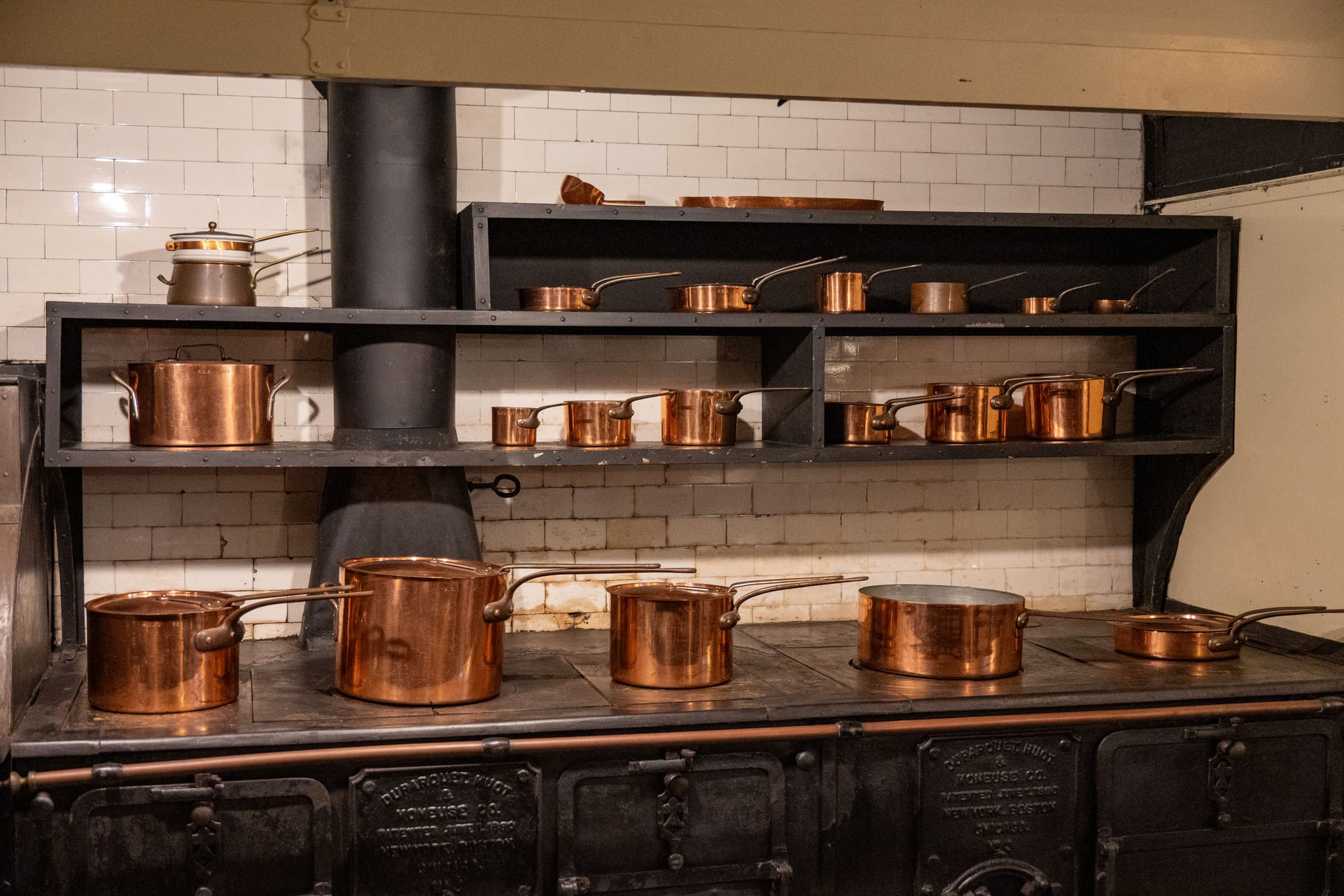
| Copper (lined) | Best heat control there is, prized for precision work | Expensive; the lining needs care; see our full copper cookware guide |
The thread that unites them: these are the pans you repair and re-season, not the ones you throw away. On a budget, one decent stainless pan plus one cast-iron or carbon-steel pan will handle almost everything, and cost less over a lifetime than a rolling series of non-stick replacements. For the premium end, our guide to copper cookware covers where it earns its keep.
None of this is about fear. A modern non-stick pan won't poison your dinner tonight. But it's a throwaway product with a genuine environmental shadow and failure modes that better cookware simply doesn't have. For a kitchen built on things that last, the case for stepping off the treadmill is a strong one.
This guide is general information, not medical advice, and it is not a claim that cooking on a modern, undamaged non-stick pan in normal use will harm you: regulators consider PTFE inert for food contact at normal temperatures, and PFOA was banned in 2020. The case made here is precautionary and environmental, plus the real, specific hazards of overheating and coating wear. Facts on PFAS, PFOA and overheating draw on IARC, the US EPA, EFSA, veterinary sources and the peer-reviewed study listed above. Guidance and chemical classifications are periodically updated, so check the current position with the Food Standards Agency and gov.uk. Last checked July 2026.
Frequently asked questions
Sources
- IARC Monographs evaluate the carcinogenicity of PFOA and PFOS (PFOA classified Group 1) , International Agency for Research on Cancer (WHO)
- Per- and polyfluoroalkyl substances (PFAS) in drinking water (4 ppt limit) , US Environmental Protection Agency
- PFAS in food: EFSA assesses risks and sets tolerable intake , European Food Safety Authority (EFSA)
- Teflon (PTFE) poisoning in birds , VCA Animal Hospitals
- Nonstick cookware as a source of microplastics and nanoplastics (single scratch estimate) , Science of the Total Environment (2022)
- Using persistent organic pollutants (POPs) (PFOA restriction) , GOV.UK / UK Environment Agency
Kit for this job (Ad)

Lodge Pre-Seasoned Cast Iron Skillet for Indoor and Outdoor Use. Induction Frying Pan. Oven, Grill and Metal Utensil Safe Skillet Frying Pan with Pouring Lips. Made in the USA. 26 cm/10.25 inch
Check price on Amazon →
Lodge L10SK3ASHH41B Cast Iron Skillet, Pre-Seasoned, 12-inch by Lodge
Check price on Amazon →
De Buyer Mineral B Black Iron Induction Frying Pan 20 cm, Size: 200(Ø)mm. Material: Blue Steel, Induction Compatible, Beeswax Coating, Suitable for all Cooking Surfaces, DN896
Check price on Amazon →
Craft Wok Traditional Hand Hammered Carbon Steel Pow Wok with Wooden and Steel Helper Handle (14 Inch, Round Bottom)/731W88
Check price on Amazon →We may earn a small commission, at no cost to you. We only list kit we'd use.
Written by
UK Homesteading Team
Editorial team
The UK Homesteading editorial team, offering UK-specific, evidence-led guidance on growing, keeping, preserving and the law.