If your home takes its water from a roof, a borehole, a well, a spring or a stream, one comfortable assumption needs challenging straight away: clear water is not the same as clean water. Rainwater picks up whatever is on your roof. Groundwater picks up whatever is in the ground. Surface water picks up whatever, and whoever, has been upstream. None of it is treated the way mains water is, and the numbers show it: in 2024 the Drinking Water Inspectorate found E. coli in 4.46% of private-supply tests in England, against roughly 0.02% on the public mains. That is the gap you are closing when you filter and disinfect an off-grid supply.
This guide walks through why off-grid water needs treating, how to find out what is actually in yours, and how to build a treatment train that removes the right things and keeps working. It sits alongside our guides to wells, boreholes and springs, rainwater harvesting and the wider picture of off-grid water systems. Read the caution below before you rely on any single device.
Why off-grid water is not automatically safe
Mains water reaches your tap after treatment and continuous monitoring by a water company. A private supply gets none of that unless you provide it. The DWI's own summary is blunt: small private and community supplies are often of poorer quality than the mains, and the indicators of faecal pollution show it. Around 1.47% of people in England rely on a private supply, and those supplies carry E. coli at roughly two hundred times the rate of the public network.
The specific things to worry about depend on your source, but the full list is worth knowing:
- Bacteria such as E. coli and coliforms, which indicate faecal contamination and can cause serious stomach illness.
- Protozoa such as Cryptosporidium and Giardia, which form tough cysts and are notoriously hard to kill with chlorine.
- Viruses, which are small enough to pass through many filters and need disinfection to remove.
- Nitrates, common where there is farming or fertiliser use nearby, and a specific risk to bottle-fed infants.
- Heavy metals such as lead, often from old pipework and plumbing rather than the source itself, and naturally-occurring iron and manganese in groundwater.
- Turbidity and sediment: the grit, silt and fine particles that not only look and taste unpleasant but shield microbes from disinfection.
That last point is the thread running through everything below. Cloudy water is not just an aesthetic problem. Turbidity physically protects bacteria and protozoa from both chlorine and UV, which is why removing particles always comes before killing microbes.
Test first: you cannot treat what you have not measured
Before you spend a penny on filters, find out what is in the water. Guessing leads to two failures at once: money spent on treatment you do not need, and a real contaminant left untouched.
Your local council is the starting point. Councils have a legal duty to keep records of private supplies in their area and to risk assess and sample them under the Private Water Supplies (England) Regulations 2016, and there are equivalent regimes in Wales, Scotland and Northern Ireland. If your supply serves two or more properties it must be risk assessed at least every five years and sampled regularly. A supply to a single dwelling is not automatically tested, but you can request a risk assessment and sample, and there is normally a fee for testing done on request. You can also commission a UKAS-accredited water-testing laboratory directly.
The treatment train: a barrier for each job
The DWI describes good treatment as a multiple-barrier approach: several stages in sequence, each treating the water to a quality the next stage can handle. No single method removes everything, so you combine them. Here is what each common stage does, and just as importantly, what it does not do.
| Treatment stage | What it removes or does | What it does NOT do |
|---|---|---|
| Sediment / pre-filtration | Grit, silt, sand and coarse particles; lowers turbidity so later stages work | Bacteria, viruses, dissolved chemicals, nitrates, metals |
| Activated carbon | Taste, odour, chlorine and some organic chemicals | Most microbes, nitrates, most metals |
| Fine / ceramic filtration | Finer particles, and to a degree some bacteria and protozoa (cyst-sized) | Viruses (too small), dissolved chemicals, nitrates |
| UV sterilisation | Kills bacteria, viruses and protozoa (incl. Cryptosporidium, Giardia) in clear water | Anything in cloudy water; chemicals, nitrates, metals; leaves no residual |
| Reverse osmosis (RO) | Almost everything, including nitrates, metals and dissolved salts | Runs slowly, wastes water to drain, needs pressure and pre-filtration |
| Boiling (rolling boil) | Kills bacteria, viruses and Cryptosporidium; the emergency fallback | Chemicals, nitrates, metals, sediment; not a permanent supply solution |
The order matters as much as the parts. A workable off-grid train runs roughly like this.
A typical off-grid treatment train
- 1
Sediment pre-filtration
Coarse then finer sediment filters strip out grit and silt, dropping turbidity so the stages behind them can do their job. This also protects the UV lamp's quartz sleeve so the light actually reaches the water.
- 2
Activated carbon
A carbon stage takes out chlorine, off-tastes and odours and some organic chemicals, improving palatability and protecting downstream membranes.
- 3
Fine or ceramic filtration
A finer or ceramic filter catches the smallest particles and some bacteria and protozoan cysts, polishing the water to the clarity UV needs.
- 4
UV sterilisation
With the water now clear, a UV unit inactivates bacteria, viruses and protozoa. It needs mains or off-grid power and a lamp in good order, and it leaves no residual, so it only treats water passing through it.
- 5
Reverse osmosis, only where the test demands it
If your test showed nitrates, metals or high dissolved solids, an RO stage (usually at a single drinking tap) removes them. It is slower, needs pressure and sends some water to waste, so it is used selectively, not for the whole house.
A note on chemical disinfection. Chlorine, usually as sodium or calcium hypochlorite, is a common and effective disinfectant for bacteria and most viruses, and some supplies use it to hold a residual in a storage tank. But the DWI is clear that chlorine is not recommended for Giardia and is ineffective against Cryptosporidium. If your source is at risk from those protozoa, UV is the recommended barrier, used instead of or in addition to chlorine. Chlorine also needs clear water and enough contact time to work, and it must be dosed after any UV stage, not before.
Matching treatment to your source
The right train depends on where your water comes from.
Rainwater from a roof
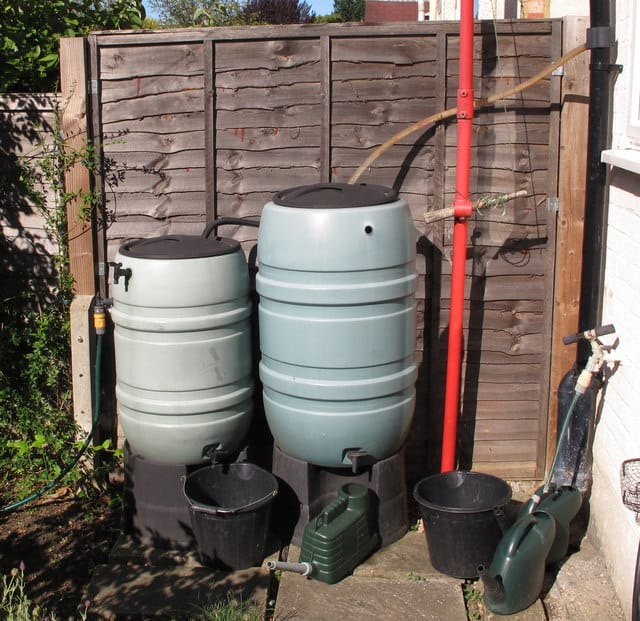
Rainwater itself is fairly clean, but a roof is not. It collects bird and rodent droppings, dust, moss, leaf litter and whatever washes off the roofing material, so roof-collected water carries a real microbial load. A first-flush diverter that dumps the initial dirty run-off is the sensible first defence, followed by good sediment filtration, then fine filtration and UV before you drink it. Roof water is generally soft and low in nitrates and metals, so RO is rarely needed; the priority is particles and microbes.
Borehole or well
Groundwater is often clearer than surface water, but "clear" is not "safe". Boreholes and wells can still carry bacteria if the headworks are poorly sealed, and they are the classic source of nitrates where there is farming nearby, plus naturally-occurring iron and manganese that stain and clog. Test specifically for nitrates and bacteria. A typical train is sediment, carbon, and UV, with iron/manganese removal or RO added only if the test shows they are needed.
Spring or stream (surface water)
Surface water carries the highest microbial risk of all, because it is open to the sky, to livestock, to wildlife and to run-off, and its quality swings wildly with the weather. It needs the fullest treatment: robust sediment pre-filtration to cope with turbidity spikes after rain, fine or ceramic filtration, and UV, ideally with monitoring so you know when a muddy surge has overwhelmed the filters. Treat a spring or stream as guilty until proven innocent, and re-test after any change in weather or land use upstream.
Boiling: the emergency fallback
When treatment fails, or the council issues a boil-water notice, boiling is the reliable stop-gap. The DWI advice is to bring the water to a rolling boil, take it off the heat and let it cool naturally, then store it in a clean container in the fridge and throw away anything not used within 24 hours. Heat kills or inactivates bacteria and viruses, and crucially it is also effective against Cryptosporidium, the parasite chlorine cannot touch. Use boiled or bottled water for drinking, brushing teeth, making ice, preparing food and giving to pets while a problem is unresolved. What boiling will not do is remove chemicals, nitrates, metals or sediment, and by evaporating water it slightly concentrates them, so it is a fallback for microbial safety, not a cure for a chemical problem.
Maintenance: the part that actually keeps you safe
Every stage of a treatment train is a consumable. Sediment and carbon cartridges clog, then either bypass or start to harbour bacteria if left too long. Ceramic elements need cleaning. UV lamps lose their germicidal output well before they stop glowing, so most are changed roughly once a year regardless of how they look, and the quartz sleeve needs cleaning so the light gets through. RO membranes foul and need periodic replacement. Miss these and the system quietly stops protecting you while looking perfectly normal.
Keep a written maintenance log with every filter and lamp change dated, follow the manufacturer's intervals, and re-test your water periodically to confirm the train is still doing its job. A service contract with a specialist is worth considering for anything beyond the simplest set-up.
The benchmark: UK drinking-water standards
The yardstick for "safe to drink" in the UK is not a matter of opinion. The Private Water Supplies (England) Regulations 2016, and the equivalent regulations in the other nations, set out the standards a supply must meet, and the DWI is the regulator that oversees them. The headline principle is that water must not contain any micro-organism, parasite or substance at a level that would be a potential danger to human health.
Treated well and maintained honestly, an off-grid supply can be every bit as safe as the mains. The order of operations is what makes it work: test first so you know what you are dealing with, build a train that removes the right things in the right sequence, keep the water clear so disinfection can work, and change the consumables before they fail. Do that, and the tap in your off-grid kitchen is one you can trust.
This is general guidance for UK off-grid households, not legal, engineering or medical advice, and it does not replace a proper risk assessment of your own supply. Drinking-water rules and standards differ between England, Wales, Scotland and Northern Ireland and are updated over time. Always confirm the current position with your local council's environmental health team and the Drinking Water Inspectorate (or the Drinking Water Quality Regulator for Scotland), and have your supply professionally tested and its treatment specified for your specific source. Last checked July 2026.
Frequently asked questions
Sources
- Treatment Guide (private water supplies) , Drinking Water Inspectorate (DWI)
- Guide for private supply owners/users (chemical disinfection selection) , Drinking Water Inspectorate (DWI)
- Guidance on the use of ultraviolet (UV) irradiation for the disinfection of water supplies , Drinking Water Inspectorate (DWI)
- Receiving a Boil Water Notice , Drinking Water Inspectorate (DWI)
- Drinking Water 2024 - Private water supplies in England (Introduction) , Drinking Water Inspectorate (DWI)
- Buying a dwelling with a Private Water Supply - what do I need to know? , Drinking Water Inspectorate (DWI)
- Nitrate and private water supplies , Drinking Water Inspectorate (DWI)
- The Private Water Supplies (England) Regulations 2016 , Legislation.gov.uk
- Technical guidance to treatment (treatment process sheets) , Drinking Water Quality Regulator for Scotland (DWQR)
Kit for this job (Ad)

Personal Water Filter, Blue, 1pc
Check price on Amazon →
Potable Aqua Water Treatment
Check price on Amazon →
Potable Aqua Germicidal Water Purification Tablets
Check price on Amazon →
BRITA Marella Water Filter Jug Blue (2.4L) Starter Pack incl. 3x MAXTRA PRO Pure Performance cartridge - fridge-fitting jug with digital LTI and Flip-Lid - now in sustainable Smart Box packaging
Check price on Amazon →We may earn a small commission, at no cost to you. We only list kit we'd use.
Written by
UK Homesteading Team
Editorial team
The UK Homesteading editorial team, offering UK-specific, evidence-led guidance on growing, keeping, preserving and the law.