If you have ever dreamed of building a low-impact home on a patch of bare land, growing most of your own food and stepping largely off the grid, you have almost certainly run into the same wall the moment you mentioned planning permission. Across most of Britain, the answer to "can I put a new house on this field?" is a flat no. Open countryside is protected from scattered new dwellings, and it does not much matter how green your intentions are.
Wales is the exception, and it is a genuinely radical one. Since the policy was introduced through Technical Advice Note 6 and Planning Policy Wales at the start of the 2010s, Wales has had a formal route called One Planet Development, or OPD, that allows exactly this kind of low-impact, off-grid home in the open countryside, where normal policy would refuse it. It is the only policy of its kind in the UK. The catch is that it asks a great deal in return: you have to prove your holding will genuinely support you, tread lightly on the planet, and keep doing so under annual monitoring for the life of the permission.
This is a plain-English guide to how OPD works, not legal advice. Planning is devolved and the detail changes, so treat this as a map and confirm the current position with the Welsh Government sources and your local planning authority before you commit money or move. If you are still at the "is any of this even legal?" stage, read our companion guide on whether it is legal to live off-grid in the UK first, then come back here for the Welsh planning route specifically.
What One Planet Development actually is
One Planet Development grew out of the Welsh Government's sustainable development scheme, One Wales: One Planet, which set a long-term goal for Wales to live within its fair share of the earth's resources. That ambition was translated into planning policy: Planning Policy Wales defines OPD as development that, through its low impact, either enhances or at least does not significantly diminish environmental quality, and Technical Advice Note 6 then spells out what an applicant has to do.
In plain terms, OPD lets a household get planning permission to build and live on agricultural or open countryside land, off-grid and low-impact, on the basis that they will make their living from that land. It is aimed squarely at the smallholder, the market gardener, the permaculture grower, the low-impact builder. It is not a mechanism for a conventional executive home with solar panels bolted on. The whole policy hangs on the idea of a land-based livelihood that keeps its footprint small.
The criteria: what you have to prove
TAN 6 and the Welsh Government's practice guidance set out a set of essential characteristics that every OPD in the open countryside must have. These are the tests your application, and specifically your management plan, has to satisfy.
- A light touch on the environment. The development must positively enhance the environment where possible, and at least not significantly harm it.
- A land-based livelihood. The holding must provide for the minimum needs of the residents in terms of food, income, energy and waste assimilation in no more than five years. In other words, the land has to be capable of broadly supporting the household, not just hosting a house.
- A low ecological footprint. The development must have an initial ecological footprint of 2.4 global hectares per person or less, with a clear potential to move towards 1.88 global hectares per person over time. That 2.4 figure is roughly half the average Welsh footprint, so it demands a genuinely low-consumption life.
- Very low or zero-carbon buildings. Buildings must be low in carbon both in construction and in use, which is why OPD homes tend to be timber-framed, straw-bale, cob or similar natural builds.
- A binding management plan. The whole scheme is defined and controlled by a management plan that is reviewed and updated every five years.
- A sole residence. The OPD must be the only home of the people living there. It cannot be a second home or a holiday project.
The headline expectation is that the enterprise meets at least 65% of the household's minimum needs (food, income and energy) from the land within five years. On food specifically the guidance is more concrete: at least 30% of the household's food by value should be grown or reared on the site directly, with a further share met either from home production or from income earned by other produce grown and reared there. The income and energy "minimum needs" are described rather than pinned to a single percentage, so those are assessed case by case through the management plan and the ecological footprint analysis. Because the exact thresholds are interpreted through those documents, it is worth reading the current TAN 6 and practice guidance in full rather than relying on a single headline number.
The management plan and ongoing monitoring
The management plan is the heart of an OPD application and the thing that most distinguishes it from an ordinary planning application. It is a substantial technical document that sets out your land use, your food and income projections, your energy and water strategy, your buildings, and crucially how all of this will be monitored and evidenced over time.
Permission, if granted, is conditional on delivering that plan. The Welsh Government's monitoring cycle runs roughly like this: an annual monitoring report each year; a fuller re-run of the ecological footprint analysis in year three (36 months) to check you are on course; and a resubmitted management plan plus a fresh footprint assessment in year five (60 months) to verify you have hit the 2.4 global hectare target. After that, the same pattern repeats on a five-year cycle. This is why OPD is best understood as a way of life you sign up to, not a one-off permission you win and then forget.
The One Planet Development application journey
- 1
Find suitable land and test the idea
Identify agricultural or open countryside land in Wales and sanity-check whether a low-impact, land-based livelihood is realistic there. Talk to the local planning authority early.
- 2
Prepare the management plan
Draft the detailed management plan covering land use, food, income, energy, water and buildings, showing how minimum needs are met within five years. Many applicants get help from the One Planet Council or an experienced consultant.
- 3
Run the ecological footprint analysis
Complete the ecological footprint analysis to demonstrate an initial footprint of 2.4 global hectares per person or less, with a credible route towards 1.88 over time.
- 4
Submit the planning application
Lodge the application with the local planning authority, with the management plan and footprint analysis as the core supporting evidence. Expect the numbers to be scrutinised.
- 5
Build and live low-impact
If permission is granted, it is conditional. Build your very low or zero-carbon home and establish the holding as your sole residence.
- 6
Monitor and report every year
Submit annual monitoring reports, a year-three footprint review and a year-five resubmitted management plan, and keep to that cycle. Falling short can trigger enforcement.
How it works in practice
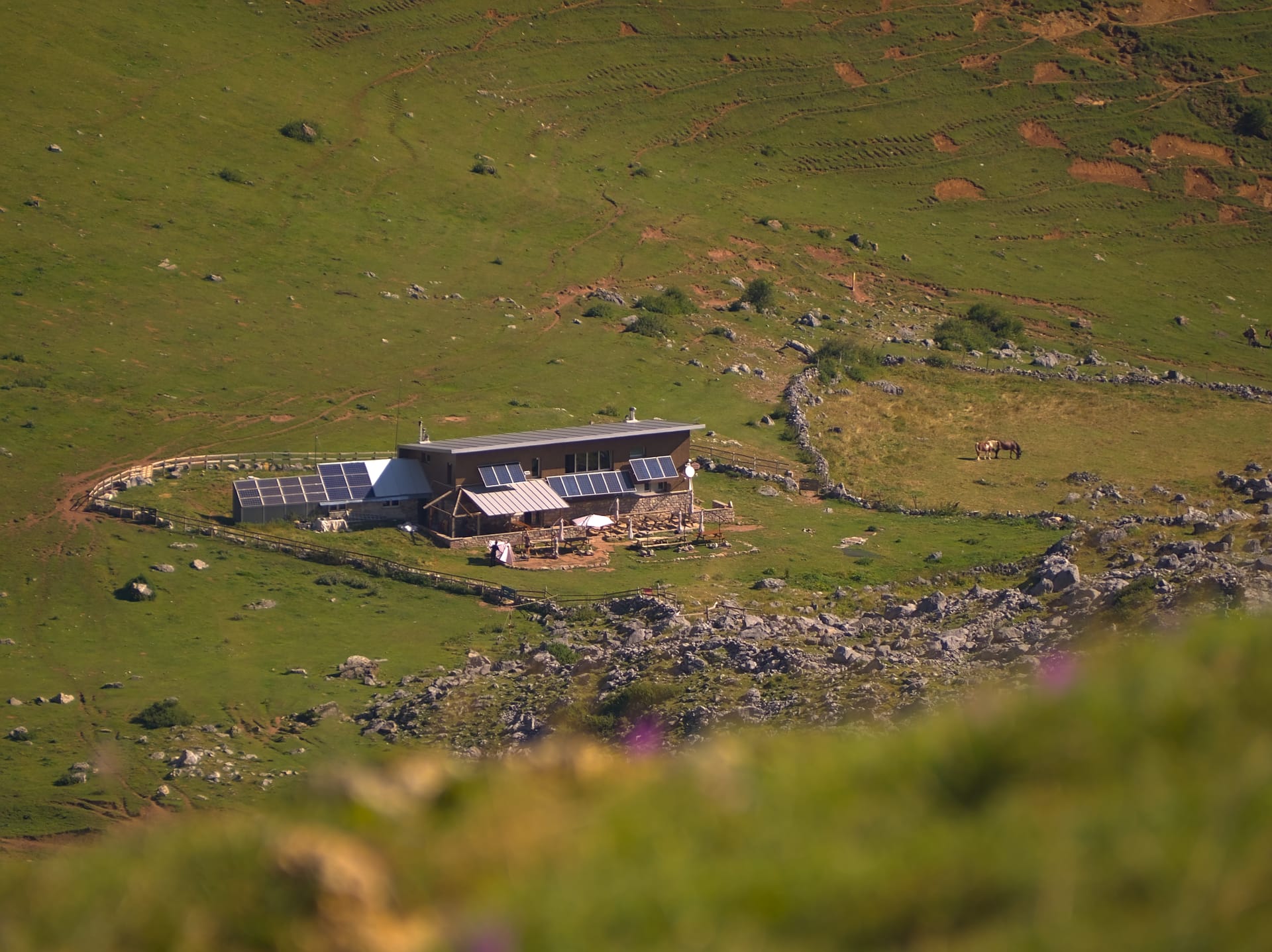
The best-known example is the Lammas ecovillage at Tir y Gafel, near Crymych in Pembrokeshire. It is a collective of low-impact smallholdings that pioneered this kind of living in Wales and helped shape the policy itself, and it remains the clearest real-world illustration of what OPD looks like on the ground: natural buildings, permaculture-based holdings, renewable energy and households making a genuine, if modest, living from the land.
Prospective applicants do not have to go it alone. The One Planet Council is a voluntary body that supports OPD applicants and local planning authorities, offering guidance and helping people navigate what is, frankly, a demanding process. Many successful applicants lean on that support, or on an experienced planning consultant, to get the management plan and the footprint analysis right. The applicants who struggle are usually the ones who underestimate just how much evidence the policy asks for.
Wales versus the rest of the UK
The contrast with the rest of Britain is stark, and it is worth being crystal clear about it, because assuming the Welsh route applies elsewhere is an expensive mistake.
| Wales | England |
|---|---|
| Has a dedicated low-impact-living policy: One Planet Development | Has no equivalent low-impact-living policy |
| New off-grid, self-sufficient homes can be permitted in open countryside if OPD criteria are met | New isolated homes in the countryside are avoided except in narrow cases |
| Route is aimed at smallholders and land-based livelihoods | Nearest route (NPPF paragraph 84) is aimed at rural workers or exceptional design, not self-sufficiency |
| Permission conditional on a monitored management plan and a 2.4 gha footprint | No footprint or self-sufficiency test in the isolated-homes exception |
In England, the relevant policy is the National Planning Policy Framework. Paragraph 84 says planning decisions should avoid isolated homes in the countryside unless one of a short list of circumstances applies, such as an essential need for a rural worker to live permanently at or near their place of work, or a design of exceptional quality that is "truly outstanding" and raises design standards more generally. That is a genuinely narrow door, and it is not built around growing your own food or shrinking your footprint. It is the exception that proves how restrictive the default is.
Scotland and Northern Ireland each run their own separate planning systems, and neither offers a direct equivalent to One Planet Development. So the headline is simple: if low-impact, off-grid living in the open countryside with a real prospect of planning permission is what you are after, Wales is, for now, the only part of the UK with a policy built to allow it. Everywhere else, you are working within much tighter general rules, and you should get nation-specific planning advice before you buy a plot or plan a build.
This guide is general information about planning policy, not legal or planning advice, and it does not replace professional advice on your specific site. One Planet Development is a Welsh policy only; the position is different in England, Scotland and Northern Ireland. Planning policy changes, so always check the current Welsh Government guidance (Planning Policy Wales and Technical Advice Note 6), the National Planning Policy Framework for England, and speak to your local planning authority before buying land, building or moving. Last checked July 2026.
Frequently asked questions
Sources
- Technical advice note (TAN) 6: planning for sustainable rural communities , Welsh Government (GOV.WALES)
- Technical Advice Note 6: Planning for Sustainable Rural Communities (full PDF) , Welsh Government (GOV.WALES)
- Planning permission: one planet developments in open countryside , Welsh Government (GOV.WALES)
- One Planet Development: practice guidance (planning permission for one planet developments in open countryside, PDF) , Welsh Government (GOV.WALES)
- National Planning Policy Framework, section 5: delivering a sufficient supply of homes (paragraph 84, isolated homes in the countryside) , Ministry of Housing, Communities & Local Government (GOV.UK)
- One Planet Council (support for OPD applicants and planners) , One Planet Council
- Lammas Ecovillage (Tir y Gafel, Pembrokeshire) , Lammas
Written by
UK Homesteading Team
Editorial team
The UK Homesteading editorial team, offering UK-specific, evidence-led guidance on growing, keeping, preserving and the law.